Showing posts with label JSA. Show all posts

Saturday, May 28, 2016

DC Universe: Rebirth #1 —Una carta de amor de Johns a la esperanza, el optimismo y el legado

Ya se publicó el primer número del DC Universe: Rebirth, y todo el mundo parece estar enamorado de él.

Rebirth es otra revisión a la continuidad del Universo DC. Es impulsada por la nostalgia, y amenaza con cometerle sacrilegio a la obra maestra y sacrosanta de Alan Moore... Pero con suficiente razón, fue bien recibido.
Rebirth en resumen.
El primer número, escrito por Geoff Johns, abre mostrando el mecanismo de un reloj que le pertenece al narrador. Es perfecto salvo por un solo engrane malo, que evita que el resto funcione. Al final,

—spoiler menor— 

se compone el engranaje. Esta metáfora es obvia: el Universo DC tiene un error (perdición, pecimismo y corte con el pasado), este primer capítulo promete arreglarlo, y empieza satisfaciendo una demanda de muchos fans. Esto es un posible presagio del final de Rebirth y de la forma en la que este cambiará el Universo DC.
Muérete de envidia, Miguel Ángel.
La continuidad que Rebirth critica se conoce como "Las Nuevas 52" o "el nuevo Universo DC" (DCnU, por sus siglas en inglés), fue creada en el 2011 tras la mini-serie Flashpoint. Como todas las continuidades anteriores, no se inició con los nuevos orígenes para cada personaje —estos vinieron después—, sino con nuevas historias que no dependen de un bagaje de años de continuidad. Resultó una eficiente introducción para muchos nuevos lectores, pero también un sacrificio de millones de páginas de la historia de DC.

Conforme fue revelado el pasado de "Las Nuevas 52" (o informalmente, el DCnU), lectores veteranos se enteraron de que muchos de sus personajes e historias favoritas nunca existieron. En las Nuevas 52 personajes como Wally West y Donna Troy no existen, las nuevas versiones de los personajes de la era dorada, como Jay Garrick o Alan Scott son demasiado diferentes y viven en una tierra paralela, el Martina Manhunter, el Hombre Elástico, y Zatanna nunca pertenecen a la Liga de la Justicia, Tim Drake apenas conoce a Batman, y así hay muchas situaciones. Además, todos los títulos perdieron la numeración que llevaban, algunos desde los años 30s. Para muchos lectores, el Nuevo 52 parecía ser negacionismo.
Una de las imágenes inaugurales de Las Nuevas 52.
Muchos fans también percibieron un exceso de violencia y pesimismo. Después de Flashpoint (2011, también por Geoff Johns), el primer número de Detective Comics muestra la cara del Joker arrancada, la primera Red Hood and the Outlaws muestra una Starfire sin recuerdos o amor por sus viejos amigos, el primer Batman muestra un psicópata versión de James Gordon Jr., y el primeros de Catwoman muestra una relación de Gatúblela con Batman meramente sexual sin emoción. Además, muchos matrimonios y relaciones de pareja (Luisa y Clark, Arthur y Mera, Ollie y Dinah, Dick y Kory) dejaron de existir.
Lo que está en juego en Rebirth.
Wally West narra la historia (esto no es spoiler, es claro desde las primeras páginas) y habla de toda la esperanza y el optimismo que se había perdido después de Flashpoint. No es que las cosas eran exactamente felices después de Crisis de Identidad (2004), pero la historia de DC todavía contaba. En Rebirth, la causa es recuperar el legado de DC.


Geoff Johns también hizo Crisis Infinita en 2005, que también se trata de la percepción de que el Universo DC es lugar oscuro y pesimista, solo que en esa historia el que quería devolver la esperanza y el optimismo, Superboy Prime, era el villano y una parodia de fanboys nostálgicos. En Flashpoint la nostalgia y el legado que se perciben y celebran como algo bueno, algo que los héroes quieren.

Claro, la identidad del villano de Rebirth es un meta-comentario sobre Watchmen (Alan Moore, 1986) y su influencia en los cómics de súperheroes. Esto deja interrogantes: ¿En verdad le echan la culpa del pesimismo y la violencia a Watchmen?¿mantendrán el punto de Watchmen intacto? ("entérese for el mismo baticanal, a la misma batihora"). Es demasiado pronto para pensar lo peor. Tratar con una franquicia tan respetada y sus personajes es una tarea compleja, veremos si Johns es capaz de manejarla.

Como un primer acto de la serie, ofrence adelantos de Ted Kord y Ray Palmer teniendo a Jaime Reyes y Ryan Choi como sus protegidos en lugar de sus remplazos, así como la promesa de regresar a los héroes de la era dorada y las relaciones amorosas. Eso es lo que está en juego en esta serie.

Como una historia Rebirth está bien. Como sucede usualmente en las historias de Johns hay mucho énfasis en los asuntos de padre e hijo, en lo que el narrador recuerda o completamente feliz o completamente trágico, o de como los chicos con el corazón en el lugar correcto superan a bullies estereotipados (en EEUU les llaman bullies de los "after school specials" de la TV).

DC Universe: Rebirth #1 no es una obra maestra Mooreana, sino un hit eficiente con muchas probadas y in esperado mensaje editorial de optimismo y esperanza. Finciona bien como una historia, pero excelente como una declaración de misión.
Esperanza, optimismo y legado.

DC Universe: Rebirth #1 —Johns's love letter to hope, optimism, and legacy

The first issue of DC Universe: Rebirth is out, and everybody seems to be in love with it. It is yet another revision to the DC Universe continuity, it is driven by nostalgia, and it threatens to commit sacrilege to the most sacrosanct masterpiece of Alan Moore... But with good reason, it was well received.
Rebirth in a nutshell.
The issue, written by Geoff Johns, opens by showing a perfectly good watch clockwork with one bad gear preventing it from working. By the end,

—minor spoiler— 

the gear is fixed. This metaphor is a no-brainer: the DC Universe is all wrong. This first chapter promises to fix the DC Universe and starts by satisfying a demand of many long time fans; more hope and optimism. The metaphor works as a possible presage to the way this series will change the DC Universe.
The Renaissance of the DC Universe.
The narrator of Rebirth criticizes the continuity created in 2011, officially called the New 52 and created after the Flashpoint mini-series. Like all previous continuities, it didn't start with the new origins of each character —those came later—, but with new stories that didn't rely on a baggage of previous stories. It was an efficient introduction for many new readers, but a sacrifice of millions of pages of DC history.

As the past of this new "the New 52" continuity was revealed, long time readers learned that many of their favorite characters and storylines never happened. In the New 52 multiverse sidekicks like Wally West and Donna Troy don't exist, the new versions of the golden age characters like Jay Garrick or Alan Scott are way too different, the Martina Manhunter, the Elongated Man, and Zatanna never belong to the Justice League, Tim Drake barely knows Batman, and so on. Furthermore, all titles lost their numbering, even those that started it in the 1930s. For many readers, the New 52 seemed to be denialism.
One of the inaugural images of the New 52.
Another perceived problem was the excess of violence and pessimism. After Flashpoint (2011, also by Geoff Johns), the first issue of Detective Comics shows the face of the Joker peeled off, the first Red Hood and the Outlaws shows a Starfire with no memoríes or emotional attachment, the first Batman shows a psychopath version of James Gordon Jr. And along with that, many marriages and love relationships (Arthur and Mera, Lois and Clark, Ollie and Dinah) ceased to exist.
This is what is at stake in Rebirth.
Wally West narrates the story (no spoiler there) and he talks about all the hope and optimism that was lost after Flashpoint. Not that things were exactly happy after Identity Crisis (2004), but all the previous DC history was still there. In Rebirth, the cause is recovering DC's legacy.

Geoff Johns also did Infinite Crisis in 2005, which is also about the perception of the DC Universe as a pessimistic dark place, only that time the guy who wanted to restore hope and optimism, Superboy Prime, was the villain and a parody of nostalgic fanboys. In Flashpoint nostalgia and legacy is perceived and celebrated as a good thing, something that the heroes want.

The identity of the antagonist of the story, of course, is a meta-commentary on Watchmen (Alan Moore, 1986) and it's influence on comics. This raises many questions. Is the story actually blaming the pessimism on it? Will Rebirth keep the point of Watchmen? This seems like a cliffhanger of the 1966 Batman show ("Tune in tomorrow. Same Bat-time, same Bat-channel, same Bat-peril") with Watchmen in Geoff's trap, but it's too soon to think negatively. Dealing with that franchise and its characters is a complex task, we will see if Johns is able to pull it in the upcoming issues.

 As a first act, it offers previews of Ted Kord and Ray Palmer having Jaime Reyes and Ryan Choi as their protegees instead of their replacements, as well as a promise to bring back the golden-agers, and love relationships. This is what is at stake for the rest of the series.

As a story it is fine. As it usually happens in Johns's stories there is a lot of emphasis on father-and-son issues, on the stuff that heroes remember as absolutely great or terribly tragic, and on how they have their hearts in the right place and they overcome after school special bullies.

DC Universe: Rebirth #1 isn't a Moorean masterpiece, but an effective hit with lots of teasing and a long expected editorial message of optimism and hope. It works fine as a story but excellent as a mission statement.
Hope, optimism and legacy.


Wednesday, July 25, 2012

The Golden Age chronology!

For no particular reason (well, there's one, but you don't get to know about it for a while), I'm posting a chronological list of the debuts of the golden age characters of DC.


1935
Oct, More Fun Comics #6 – Dr. Occult, Rose Psychic

1937 

March, Detective Comics #1 – Slam Bradley and Shorty Morgan

1938 


Apr, Action Comics #1 – Superman, Zatara, Tex Thopson
Oct, Detective Comics #20 - Crimson Avenger and Wing

1939 
May, Detective Comics #27 – Batman
Jul, Adventure Comics #40 - Sandman


1940
Jan, Flash Comics #1 – Flash, Hawkman, Hawkgirl, Johnny Thunder
Feb, More Fun Comics #52The Spectre
Mar, Adventure Comics #48 - Hourman
Spr, Batman #1 – Catwoman
Apr, Detective Comics #38 –  Robin
May, More Fun Comics #55 – Dr. Fate
Jun, More Fun Comics #56 - Congo Bill
Jul, All-American Comics #16Green Lantern
Oct, All-American Comics #19The Atom
Nov, All-American Comics #20 – Red Tornado
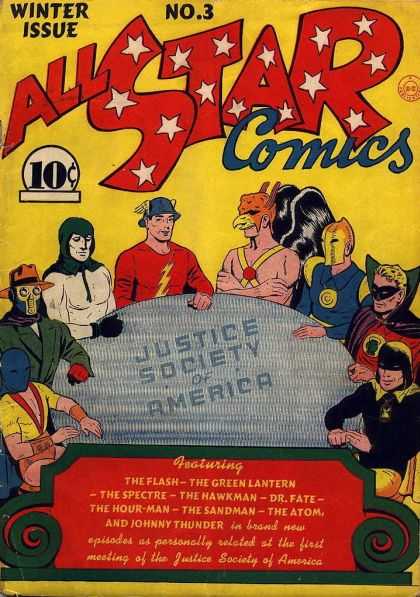
Win, All-Star Comics #3 The Justice Society of America (Hawkman, Atom, Flash, Green Lantern, Dr. Fate, Spectre, Hurman and Sandman).

1941
Apr, All-American Comics #25 – Dr. Mid-Nite
Apr, Adventure Comics #61 - Starman
Sep, More Fun Comics #73 – Aquaman, Green Arrow, Speedy
Sep, Adventure Comics #66 – Shining Knight
Sep, Action Comics #40 – Star-Spanged Kid, Stripesy
Oct, All-Star Comics #8 - Wonder Woman
Oct, Star-Spangled Comics #1 - Tarantula
Nov, Action Comics #42 – Vigilante
Winter, Boy Commandos #1 – Liberty Belle
Winter, Leading Comics #1 Seven Soldiers of Victory

1942
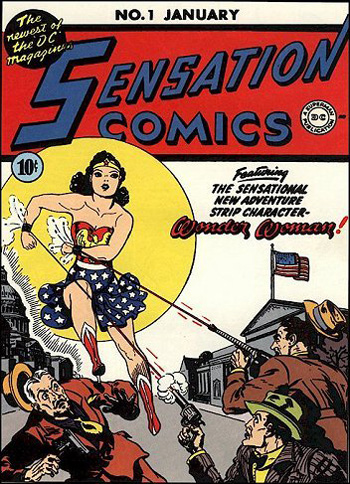
Jan, Sensation Comics #1Wildcat, Mr. Terrific
Feb, Detective Comics #60 – Air Wave
Apr, Star-Spangled Comics #7 – Robotman, TNT and Dan the Dyna-myte, The Guardian


1947
Aug, Flash Comics #86Black Canary

1948
Jun, - Star-Spangled Comics #81 – Gimmick Girl

1983
Jul, All-Star Squadron #23 – Amazing Man


Adoptive characters

A bunch of current DC Comics properties were created outside National Comics / All-American Publications. In this list I'm mixing Fawcett Comics, Quality Comics and Fox Comics. However, it must first  be considered that [besides the ancient and classic god pantheons and the biblical characters] certain classic characters that exist in the current DCU were created even before that:

c. 9th Century: King Arthur, Merlin, and the Knights of the Round Table
c. 1422: Robin Hood
1887: Sherlock Holmes and John Watson
1904: Rima, the Jungle Girl
1912: Tarzan
1933: Doc Savage

1939
Aug, Mystery Men Comics #1 Blue Beetle

1940
Feb, Whiz Comics #2Captain Marvel, Spy Smasher
May, Nickel Comics #1 – Bulletman and Bulletgirl
May, Crack Comics #1 – Black Condor
Jul, National Comics #1Uncle Sam
Jun, Register and Tribune SyndicateThe Spirit
Sept, Smash Comics #14 – The Ray

1941
Aug, Police Comics #1 – Plastic Man, Phantom Lady, Human Bomb, Firebrand
Aug, Military Comics #1 – Miss America, Blackhawks
Dec, Whiz Comics #25 – Captain Marvel Jr.

1942
Dec, Captain Marvel Adventures #18 Mary Marvel

1943
Jul, Military Comics #20 – Lady Blackhawk (unnamed)
Oct, Wow Comics #18 – Uncle Marvel

1944
Apr, Feature Comics #77 – Doll Man

It is interesting to note that in both cases, most of the characters were created between January 1940 and December 1941, and that, in general, they also had more staying power than the rest, with the exception being the two big archetypes that predate them: Superman and Batman.


Villains

And finally the villains (I might do supporting cast if I'm ever in the mood). It's funny I'd have never expected Wonder Woman to have the clearest gallery or Superman to be so difficult.
In this case we can also appreciate that, unlike superheroes, must of the villains were not created in 1940 or 1941. However, many archenemies are from those years: Luthor, Joker, Catwoman, Clayface, Scarecrow, Penguin, Hugo Strange, Sivana, Captain Nazi, Wotan, Karkull, Mr. Who, Hath Set, Dummy, Zor, Oom and Blackjack (hey, he was basically the only Aquaman guy back then!)

Wonder Woman
1942, Feb, Sensation Comics #2 – Doctor Poison
1942, Apr, Sensation Comics #4 – Baroness Paula von Gunther
1942, Sum, Wonder Woman #1 – Ares
1942, Fall, Wonder Woman #2 – Duke of Deception, Lord Conquest, Earl of Greed
1943, Apr, Wonder Woman #4 - Mavis
1943, Jun, Wonder Woman #5 – Dr. Psycho
1943, Oct, Wonder Woman #6 – Cheetah
1943, Dec, Comic Cavalcade #5 -Zara
1944, Mar, Wonder Woman #8 – Queen Clea
1944, Jun, Wonder Woman #9 – Giganta
1944, Fall, Wonder Woman #10 – Eviless
1944, Win, Wonder Woman #11 – Hipnota
1945, Apr, Sensation Comics #42, Draska Nishki              
1946, Sep, Sensation Comics #59 – Blue Snowman
1946, Oct, Comic Cavalcade #17 – Gunra the Valkyrie
1947, Jul, Wonder Woman #24 – The Mask
1948, Mar, Wonder Woman #28 – Villainy Inc.
1948, Apr, Wonder Woman #29 – Minister Blizzard
1949, Sep, Wonder Woman #37 - Circe
1953, Nov, Wonder Woman #62 – Angle Man


Batman
Wasn't able to get any Kane gallery, but here's some Sprang.
1939, Jul, Detective Comics #29 – Dr.  Death
1939, Sep, Detective Comics #31 – Monk & Dala
1940, Feb, Detective Comics #36 – Professor Hugo Strange
1940, Spr, Batman #1 – The Joker
1940, Apr, Detective Comics #38   Boss Zucco
1940, Jun, Detective Comics #40 - Clayface
1941, Fall, World’s Finest Comics #3 – The Scarecrow
1941, Dec, Detective Comics #58 – The Penguin
1942, Ago, Detective Comics #66 – Two-Face
1943, Apr, Detective Comics #74 – Tweedle Dee & Tweedle Dum
1943, Nov, Detective Comics #81 – The Cavalier
1947, Sep, World's Finest Comics #30 – The Penny Plunderer
1948, Oct, Batman #49 – The Mad Hatter
1950, Jun, Batman #59 – Deadshot  
1951, Feb, Batman #63 – Killer Moth
1952, Jun, Detective Comics #184 - Firefly
1983, Jul, The Brave and the Bold #200 – Brimstone

Captain Marvel
1940, Feb, Whiz Comics #2 – Dr. Sivana
1941, Dec, Master Comics #21 – Captain Nazi
1942, Mar, Captain Marvel Adventures #8 – Mr. Banjo, Ibac
1942, Apr, Captain Marvel Adventures #9 – Nippo
1943, Feb, Captain Marvel Jr. #4, Sabbac
1943, Mar, Captain Marvel Adventures #22 - Herkimer
1943, Ago, Captain Marvel Adventures #26 – Mr. Mind, Goat Man
1944, Jun, Captain Marvel Adventures #36 - Jeepers
1944, Nov, Captain Marvel Adventures #41 – Evil Eye
1945, Dec, Marvel Family #1 – Black Adam
1946, May, Captain Marvel Adventures #61 – Oggar
1947, Nov, Captain Marvel Adventures #78 – Mr. Atom
1951, Oct, Captain Marvel Adventures #125 – King Kull


Superman
1939, Jun, Action Comics #13 – Ultra-Humanite
1940, Jan, Action Comics #20 – Dolores Winters (who woud become Ultra-Humanite)
1940, Apr, Action Comics #23 – Lex Luthor
1941 Nov, Superman #13 – The Archer
1942 Aug – Action Comics #58 – The Prankster
1942 Nov, Superman #19 – Funny Face
1942, Jun, Action Comics #49 – The Puzzler
1942, Sum, World’s Finest Comics #6 – Metalo
1943, Sep,  Action Comics #64 – Toyman
1943, Nov, Superman #25 – Hi-Jack
1944, Jan, Superman #26 - J. Wilbur Wolfingham
1944, Sep, Superman #30 – Mr. Mxyzptlk
1950, Feb, Superboy #6 – Humpty Dumpty

Flash
1942, Sep, Flash Comics #33 – The Shade
1942, Dec, Flash Comics #36 ­– Rag Doll
1943, Fall, All Flash Comics #12 – The Thinker
1945, Win, All Flash Comics #21 – The Turtle
1947, Nov, Flash Comics #89 - Thorn
1947, Dec, All Flash Comics #32 – The Fiddler, Star Sapphire
1949, Feb, Flash Comics #104 – The Rival

Green Lantern
1943, Win, Green Lantern #10 – Vandal Savage
1944, Sum, Green Lantern #12 – The Gambler
1944, Oct, All-American Comics #61 – Solomon Grundy
1947, May, All-American Comics #85 – Sportsmaster
1947, Ago, Green Lantern #27 – Sky Pirate
1947, Sep, All-American Comics #89 – Harlequin
1947, Oct, All-American Comics #90 – Icicle


Dr. Fate
1940, May, More Fun Comics #55 - Wotan
1941, May, More Fun Comics #67 – Nergal
1941, Jul, More Fun Comics #69 – Ian Karkull 
1941, Nov, More Fun Comics #73 – Mr. Who
1942, Jun, More Fun Comics #80 – Octopus
1942, Jul, More Fun Comics #81 – The Clock

Justice Society of America
1943, Feb, All-Star Comics #15 – Brainwave
1945, Win, All-Star Comics #23 – Psycho-Pirate
1947, Apr, All-Star Comics #34 – The Wizard
1947, Jun, All-Star Comics #35 – Per Degaton
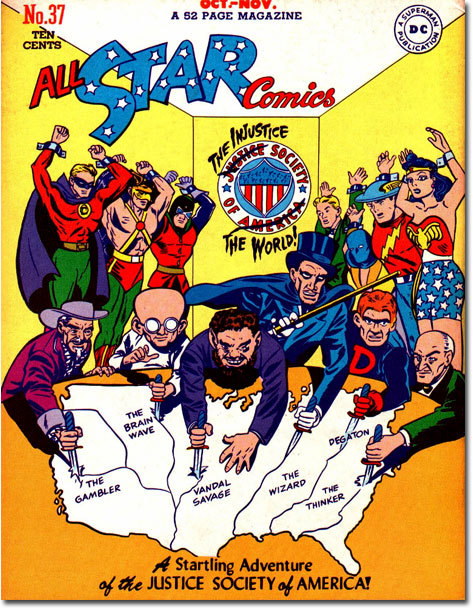
1947, Oct, All-Star Comics #37 – Injustice Society of the World 
1948, Dec, All-Star Comics #44 – Evil Star
1951, Mar, All-Star Comics #57 – The Key
1999, Dec, Secret Origins of Super-Villains 80-Page Giant #1 – Johnny Sorrow

Hawkman
1940, Jan, Flash Comics #1 – Hath Set
1940, Fall, All-Star Comics #2 - Nyola
1941, Jan, Flash Comics #13 – Satana
1945, Apr, Flash Comics #64 – The Monocle
1947, Oct, Flash Comics #88 – The Gentleman Ghost


Plastic Man
1950, May, Plastic Man #23 – The Figure
1950, Sep, Plastic Man #25 – Mr. Aqua

The Spectre
1940, May, More Fun Comics #55 –  Zor
1940, Win, All-Star Comics #3 – Oom

Aquaman
1941, Dec, More Fun Comics #74, Blackjack

Green Arrow
1946, Sep, World's Finest #24 – Bulls-Eye

Dr. Mid-Nite
1947, Feb, All-American Coics #82 - Dr. Light

Starman
1941, May, Adventure Comics #62 – The Light
1941, Oct, Adventure Comics #67 – The Mist

Vigilante
1941, Win, Leading Comics #1 – The Dummy

Zatara
1938, Apr, Action Comics #1 – The Tigress
1938, Oct, Action Comics #5 – Amen-Hotep

Congo Bill
1940, Jun, More Fun Comics #56 - The Skull

Robotman
1943, Feb, Star-Spangled Comics #17 – The Turtle

Wildcat
1943, Ago, Sensation Comics #20 – Yellow Wasp
1947, Ago, Sensation Comics #68 – The Huntress

Sandman
1942, Sum, World’s Finest Comics #6  - Ramulus

Boy Commandos
1946, Jun, Boy Commandos #15 – Crazy Quilt


RELATED ARTICLES: