Showing posts with label Wonder Woman. Show all posts

Saturday, July 23, 2016

Zack Snyder tweets the first Justice League trailer.


The bits in the trailer are visually similar to Batman v Superman, even with the bluish hue, yet the tome is very similar to that of a Marvel movie.

Snyder might have taken notes from his critics, besides the humor, and more joyful attitude of the characters, Ezra Miller looks a lot les like a slacker and more like the TV version.

It is also noteworthy that Bruce Wayne is the one recruiting other heroes, not Batman.

It is also noteworthy that the Elongated Man is not included in this movie. Well, no, that's comes without saying, but I noticed anyway.

Thursday, May 5, 2016

The first Superheroines in comics

It is common to think the superhero genre is dominated by male protagonists, and it is. It has been that way since the beginning... although not as much as we think. A little googling and some listing can show us that there were a lot of golden age superheroines (or mystery women) and that they were as talented and independent as their male counterparts.

After reading a bit about Lady Luck, the theme picked my interest, and since the last month, I've been doing this list on my free time. It covers superheroines of the golden age of comic books (c. 1936 - 1953) and provides basic info on each character (publishers, first appearance, general premise), as well as some comments I make about their innovations, influences, originality, fashion sense, impact, and influence.

This is a really long post and I don't expect anybody to read the whole thing. However, it has many sections about different characters, so it's a "pick your favorite" sort of situation. The advantage is that having all of it in one post allows us to compare and see the relevance of each character.

Good girl art, superheroines, censorship, and feminism

By comparing superheroines with their male counterparts, we can get an idea of their equality. It's clear that publishers were just cashing on the "good girl art" (drawn pin-ups with a focus on their "headlighs" and other female parts —the term was coined later by David T. Alexander), which resulted from making female versions of popular male superheroes, without realizing the positive implications for equality and feminism. They were creating fictional women who were not only equal to regular men but epic superhumans, such as Tarzan, Buck Rogers, The Shadow, The Phantom or Superman.

A little context is necessary. The golden age of comic books coincided with the Hays Code, which moderated the amount of violence or sex (or even cleavage) movies could show, and was enforced from 1934 to the late 1950s. Since pulps and comics were largely uncensored back then, they became the biggest outlet for that kind of content. And the fastest way for publishers to serve it was drawing women in Tarzan or Flash Gordon mini-costumes beating thugs.
I think this image is making a commentary about its readers.
One could certainly argue that such representations objectified women —titillating male readers and indulging their escapism, and they certainly do all of that—, but they also made them look like their counterparts: admirable men in even fewer clothes. If Sheena, Mysta or Namora wear skimpy clothes, Tarzan, Flash Gordon or Namor wear even skimpier ones, and the six of them have skills beyond normal men. This is the rationale that made feminist Gloria Steinem ask DC Comics to bring back Wonder Woman's star-spangled bottom.


Sunday, July 6, 2014

The Periodic Table of Superheroes

It's funny how as awesome as it is I can't help but nitpick minor details. Like The Atom, Speedy and Mr. Mxyzptlk so notoriously missing. They were popular during that era, as well as Cyborg, Starfire, Raven and Beastboy. Harley has nothing to do there (although, retroactively, it would have been a really cool thing to see), and I feel that the Scarecrow, Captain Cold, Grodd, Black Manta, Zod, Solomon Grundy, Sinestro, Sivana, Mr. Mind and Mordru were more popular than Two-Face. That being said, we have to note that whoever did this grouped heroes by families, which wouldn't have made easy to fit everyone there. It's fun to play with these ideas, anyway.

Sunday, December 1, 2013

Every comic book documentary you must watch


Well, not all of them, but at least I have your attention now.

After watching PBS's wonderful "Superheroes: A Never Ending Battle" I was left with an itch for more documentaries like that. However, there were much fewer than I would have imagined. So, here are some of the best.

Comic Book Confidential

This documentary produced by Metro-Goldwyn-Mayer features the whole picture of the comic-book phenomenon in the United States as of 1988. The origins of the medium, the evolution of superheroes and all the other genres as they born in different eras: horror, comedy, underground, etc. All of this clearly contextualized and documented with nice production values and lots of style. I'd say this is one is essential (thanks, Frank!).


I did not want to add the whole movie in this case, but by the time I posted these videos, the full movie was available at youtube. It has Spanish subtitles, though.

Superheroes: A Never Ending Battle   

Produced by PBS, this is basically a three-hours intensive "History of Superheroes 101".  It is split into three episodes.


The first part, "Truth Justice and the American Way", deals with the origins of the superhero genre, how they represent the American dream, and their ties to the World War II era.

"Great Power, Great Responsibility" is about the silver age resurrection of the genre after Frederick Wertham crippled the comic book industry. This part explains the influence of the atomic age and the cold war on superheroes, as well as their new troubled lives and the transition into the bronze age.

Finally, "A Hero Can Be Anyone" covers the modern era, showing their more mature tone and how popular culture has embraced superheroes in recent years.

If you want to see a better description of the special, here are their creators in their Comic-Con 2013 panel:

Comic Book Superheroes Unmasked

This is History Channel's take on the superhero tradition. Everything you need to know in an hour and a half.


Tales from the Crypt - From Comic Books to Television

After watching all those documentaries, we get the big picture of American comic book superheroes, but our understanding of American comics is still quite incomplete. A big missing piece would be the history of EC Comics and how its explicit content lead to the creation of the Comics Code Authority that censored content during the silver age. This 2004, CS Films documentary covers all the basics. 


Overstreet's World of Comic Books

This one is pretty funny. It was done in 1994 and apparently, back in those times the comic book industry was booming like it was during the golden age. I can't help but think about what was about to happen back then.
I think it's worth seeing not only because we get the perspective of a slightly different era, but also because it features a lot of guys we wouldn't be able to see in more recent documentaries.


Wonder Women! The Untold Story of American Superheroines

Here we have some focus on the history of superheroines and their influence on feminist movements. Before watching this I had no idea women actually cared that much about Wonder Woman. Good for them.


Super Heroes United - The Complete History Of The Justice League

Among various extras in the Justice League: The New Frontier (2008) DVD, Super Heroes United presents the history of DC's premier team. As a Justice League documentary it rushes through all the eras, leaving out important stuff, like the roster of the satellite era, for instance. However, it does a good job presenting the DC transition from golden age to silver age, something that was missing in documentaries like Superheroes: A Never Ending Battle.


Comics Britannia

BBC's version of what was going on across the pound. Even though we love to adopt every brilliant idea the British ever have and make it par of our culture, and even though we are well aware that they somehow produce ridiculously talented giants like Alan Moore, Neil Gaiman or Grant Morrison, we still don't really know what is going on there. This series is quite eye opening. We need that kind of comic book culture over here.


In Search of Steve Ditko


Jonathan Ross' attempt to track down Steve Ditko, one of the most influential, enigmatic and idiosyncratic creators in the American comic book industry (Spider-man, Dr. Strange, The Question, Blue Beetle). This documentary was produced for BBC Four.

The rest of the documentary is available on Youtube.

Moebius Redux


In order to fully understand the potential of comic book art, this documentary is a must. The way I see it, Moebius is the Michelangelo of comics, and this BBC Four documentary is a great introduction to his world. 


Jack Kirby, Storyteller


.Jack is the King. Without him, American comics and the entire superhero genre would have a completely different vibe. It has been said that he created half the characters of Marvel and DC. Half. If all you can think when you see his stuff is how chunky it is, you need to watch this video.


NOTES:

  • Please, let me know in the comments section if a link gets broken.
  • I'll continue adding videos to this post as they become available. I might take recommendations from the comments.
  • I don't know much about copyrights, so I'm just going by whatever Youtube allows. In any case, readers can always report them whatever they see here.
  • UPDATE: Following Frank's suggestion I added Comic Books Confidential  

Thursday, January 31, 2013

More Elongated art!


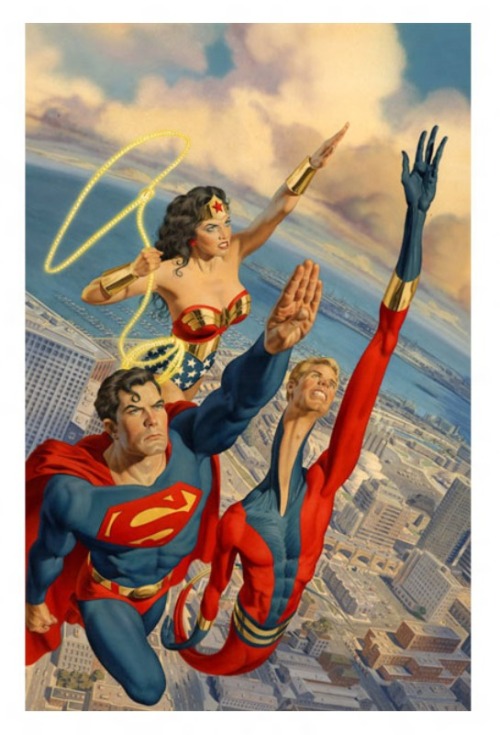
This image by Mark Stutzman deserves its own post I have to know the history behind it. I guess the trinity had to go for the Best next thing after Batman in whatever that adventure was (apparently a commission for a Fusion Toys puzzle series). Oddly enough, Ralph was a lot closer with Batman and only teamed-up once with Wonder Woman.


Blackest Night - the Atom & Hawkman #46


Hawkman and the Atom #46, art by Ryan Sook.

I believe this one was done by Willis Bulliner. And I guess that's Ralph saluting TPTB for his fabulous role in the New 52.

Thursday, July 26, 2012

¡Viva los Superhéroes!: Yes, they have different names in Spanish

I was recently asked about my nickname (no, Rafa Rivas is not my real name). It comes from "Rafael Rivas", the real name the Elongated Man or El Hombre Elástico gets in Spanish translations.
Clark Kent is still Clark Kent, no Spanish name for him. However, most superheroes, villains and supporting characters have Spanish names like that.

So, just because, here is a list of the most notorious ones. I'll write in gray the most accurate they could have used instead (but didn't).


Superman / Clark Kent: Supermán / Clark Kent. 
Batman / Bruce Wayne: Batman / Bruno Díaz.
Robin / Dick Grayson: Robin / Ricardo Tapia.
Wonder Woman / Diana Prince: Mujer Maravilla (o Marvila) / Diana Pérez. Diana Príncipe.
Wonder Girl / Donna Troy: Chica Maravilla / Dina Rosas. Dona Troya 
Elongated Man / Ralph Dibny: Hombre Elástico / Rafael Rivas. 
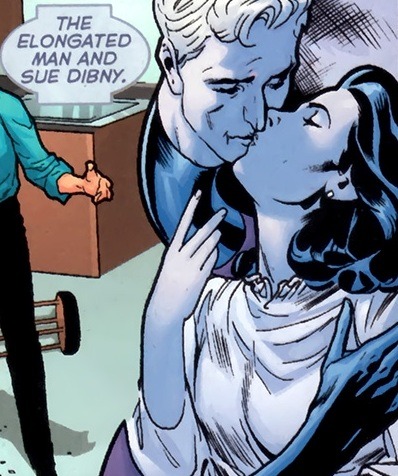
Sue Dibny: Susana Rivas.
Supergirl / Linda Lee: Superchica / Linda Lara.
Aquaman: Aquamán (can't recall if there was any translation for Arthur Curry, but it's likely Arturo something). Arturo Curi (although it would make him a Latin Lebanese). 
Green Lantern / Hal Jordan: Linterna Verde / Raúl Jordán. Hal (Haroldo) Jordán.
Flash / Barry Allen: Flash / Bruno Alba. "Flushman" in Argentina (for some reason).
Kid Flash / Wally West: Flashito / Carlos Vela. Gualter Oeste.
Martian Manhunter / John Jones: Detective Marciano / Julio Jordán. Juán Juanez.
Hawkman / Carter Hall: Hombre Halcón / Carlos Lara. Carlos Salón. 
Hawkwoman / Shiera Hall: Mujer Halcón / Mirna Lara.
Green Arrow / Oliver Queen: Flecha Verde / Oliverio Reyna. 
Black Canary / Dinah Lance: Canario Negro / Diana Ríos. Dina Lanza.
Atom / Ray Palmer: Átomo / Ray Palmer. Raymundo "Ray" Palmera.
Adam Strange: Adán Luna. Adán Extraño.
Zatanna: Zitana. That one seems to makes no sense, as zitana is meaningless. Zatanna.
Batgirl / Barbara Gordon: Batichica / Bárbara Fierro.
Red Tornado / John Smith: Tornado Rojo / Juan Pérez. 
Flash I / Jay Garrick: Flash / Jorge Forcada.
Firestorm / Ronnie Raymond: Antorcha / Ronnie Raymond. Ronaldo Raymundo.
Captain Marvel / Billy Batson: Capitán Maravilla / Memo Batson. Beto Basto.
Guy Gardner: Gil Garza. Gil Jardinero. (G and J sound alike in Spanish).
Mr. Miracle / Scott Free: Sr. Milagro / Oscar Liberal.
Starman: Astro.
Hourman: Horario.
Wildcat: Gato Montés.
Johnny Thunder: Juan Trueno.
Sandman: Arenero.
Starfire: Nova.
Changeling: Mutante.
Raven: Corvina.
Darkseid: Oscuranto, Morbus or Penumbra.

With Superman characters they tend to keep both names or at least the last one in English:
Lex Luthor: Lex Luthor.
Lois Lane: Luisa Lane.
Jimmy Olsen: Jaime Olsen. Jaime Olmos.
Perry White: Pedro White. Pedro Blanco.
Lana Lang: Lina Luna.
Pete Ross: Pedro Ross or Fernando Suárez.
Brainiac: Cerebro ("Brain"). Cerebrático.
Metallo: Metálico ("Metallic"). Metalo.
Parasite: Parásito.
Mr. Mxyzptlk: Senor Mxyzptlk (pronounced misleplik).
Bizarro: Bizarro (And "bizarro" is Spanish for "bizarre").
Krypto: Krypto.

Batman characters:
Commissioner Gordon: Comisionado Fierro.
Catwoman: Gatúbela (close to "Catarella", like Vampirella or Barbarella).
Joker: Guasón or Arlequín.
Penguin: Pingüino.
Mr. Freeze: Capitán Frio (Somehow they gave him the name that should be used for the enemy of the Flash —sometimes they use "Señor Gélido", a better translation).
The Riddler: El Acertijo.
Egghead: Cascarón (meaning "Eggshell"). Cabeza de Huevo.
King Tut: Rey Tut.
Gotham City: Ciudad Gótica.
Poison Ivy: Hiedra Venenosa, or Hortiga.
Two-Face: Dos Caras or Doble Cara ("Double Face").
The Ventriloquist / Scarface: Ventrílocuo / Cara Marcada.
Clayface: Cara de Barro.
Harley Quinn: Arlequín (sometimes Arly Quin).

Teams
Justice League of America: La Liga de la Justicia de América ("de América" is rarely said).
Justice Society of America: Los Defensores de la Justicia ("de América" is rarely said).
Doom Patrol: La Patrulla Salvadora o El Escuadron Suicida (that last one is "Suicide Squad", lol).
Teen Titans: Los Héroes Juveniles o Los Jóvenes Titanes. Los Adolescentes Titanes.
Wonder Twins: Gemelos Fantásticos.

Cities, places, and stuff
Gotham City: Ciudad Gótica ("Gothic City").
Metropolis: Metrópolis.
Krypton: Krytón or Kriptón.
Smallville: Villa Chica.
Coast City: Ciudad Costera.
The Watchtwer: La Atalaya.
The Batcave: La Baticueva (a made-up word).
Batmobile: Batimovil (another made-up word —since "bat" is "murciégalo", and that's too long, anything Batman-related is translated with the meaningless prefix "bati-", as in Batichica, Batibúmerang, Bati).
The Daily Planet: El Planeta ("The Planet").


Marvel:
Spider-man / Peter Parker: El Hombre Araña / Pedro Márquez.
Dr. Octopus: Dr. Pulpo.
Green Goblin: E Duende Verde. El Orco Verde.
Sandman: El Arenero.
Fatastic Four: Los Cuatro Fantásticos.
Mr. Fantastic / Reed Richards: Sr. Fantástico / Enrique Ricardo.
Invisible Woman / Sue Storm: La Mujer Invisible / Susana Sánchez.
Human Torch / Johnny Storm: La Antorcha Humana / Juan Sánchez.
The Thing / Ben Grimm: La Mole / Benito Gris. La Cosa.
Dr. Doom: Dr. Muerte. Dr. Perdición.
Galactus: Alberto el Hambriento (Hilarious! That means "Hungry Albert").
X-Men: La Patrulla-X, Los Hombres X ("X" or "equis" is a bit funny, because the word modern slang for "generic", "indifferent", or "it's ok").
Wolverine / Logan:  Guepardo / Leonardo (keep in mind that "guepardo" is Spanish for cheetah). Also: Emilio Garra, Lobezno, Carcayú, Glotón, Aguja Dinámica ("Dynamic Needle") and Aullador ("howler"). Carcayu. Carcayú or glotón are the right way to call a wolverine (gulo gulo), and "lobezno" is only ok for a wolf pup).
Morpho: Morfo.
Professor X / Charles Xavier: Profesor X (the X is pronounced "equis") / Carlos Xavier (prounounced "ha•vee•er"). He is often called "Profesor Xavier" instead of Profesor X.
Magneto: Magneto (although "a magnet" is "un magneto" in Spanish).
Rogue / Titania. Pilla.
Daredevil: Dan Defensor ("Dan Defender"), or Diabólico (Diabolic). Tough one. Dan Defender is pretty bad, but the translation would be "Temerario", which has no D or anything to do with "devil".
Dr. Strange: Dr. Centella. Dr. Extraño.


Wednesday, July 25, 2012

The Golden Age chronology!

For no particular reason (well, there's one, but you don't get to know about it for a while), I'm posting a chronological list of the debuts of the golden age characters of DC.


1935
Oct, More Fun Comics #6 – Dr. Occult, Rose Psychic

1937 

March, Detective Comics #1 – Slam Bradley and Shorty Morgan

1938 


Apr, Action Comics #1 – Superman, Zatara, Tex Thopson
Oct, Detective Comics #20 - Crimson Avenger and Wing

1939 
May, Detective Comics #27 – Batman
Jul, Adventure Comics #40 - Sandman


1940
Jan, Flash Comics #1 – Flash, Hawkman, Hawkgirl, Johnny Thunder
Feb, More Fun Comics #52 – The Spectre
Mar, Adventure Comics #48 - Hourman
Spr, Batman #1 – Catwoman
Apr, Detective Comics #38 –  Robin
May, More Fun Comics #55 – Dr. Fate
Jun, More Fun Comics #56 - Congo Bill
Jul, All-American Comics #16 – Green Lantern
Oct, All-American Comics #19 – The Atom
Nov, All-American Comics #20 – Red Tornado
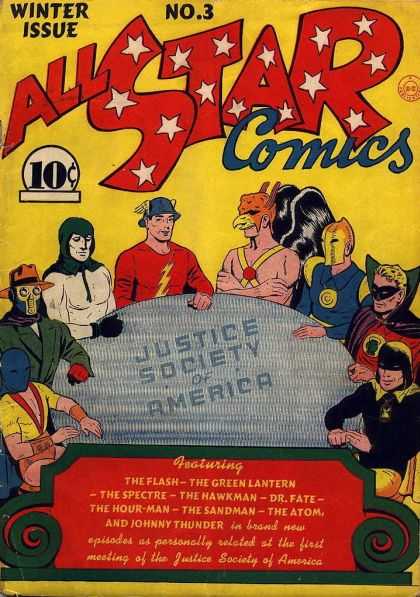
Win, All-Star Comics #3 – The Justice Society of America (Hawkman, Atom, Flash, Green Lantern, Dr. Fate, Spectre, Hurman and Sandman).

1941
Apr, All-American Comics #25 – Dr. Mid-Nite
Apr, Adventure Comics #61 - Starman
Sep, More Fun Comics #73 – Aquaman, Green Arrow, Speedy
Sep, Adventure Comics #66 – Shining Knight
Sep, Action Comics #40 – Star-Spanged Kid, Stripesy
Oct, All-Star Comics #8 - Wonder Woman
Oct, Star-Spangled Comics #1 - Tarantula
Nov, Action Comics #42 – Vigilante
Winter, Boy Commandos #1 – Liberty Belle
Winter, Leading Comics #1 – Seven Soldiers of Victory

1942
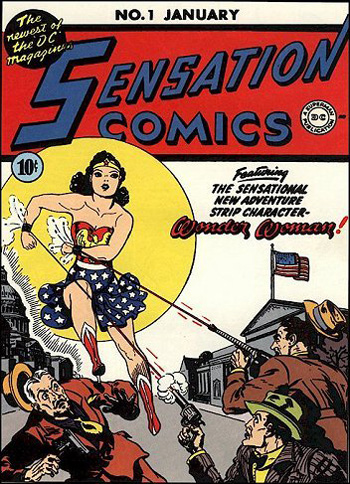
Jan, Sensation Comics #1 – Wildcat, Mr. Terrific
Feb, Detective Comics #60 – Air Wave
Apr, Star-Spangled Comics #7 – Robotman, TNT and Dan the Dyna-myte, The Guardian


1947
Aug, Flash Comics #86 – Black Canary

1948
Jun, - Star-Spangled Comics #81 – Gimmick Girl

1983
Jul, All-Star Squadron #23 – Amazing Man


Adoptive characters

A bunch of current DC Comics properties were created outside National Comics / All-American Publications. In this list I'm mixing Fawcett Comics, Quality Comics and Fox Comics. However, it must first  be considered that [besides the ancient and classic god pantheons and the biblical characters] certain classic characters that exist in the current DCU were created even before that:

c. 9th Century: King Arthur, Merlin, and the Knights of the Round Table
c. 1422: Robin Hood
1887: Sherlock Holmes and John Watson
1904: Rima, the Jungle Girl
1912: Tarzan
1933: Doc Savage

1939
Aug, Mystery Men Comics #1 – Blue Beetle

1940
Feb, Whiz Comics #2 – Captain Marvel, Spy Smasher
May, Nickel Comics #1 – Bulletman and Bulletgirl
May, Crack Comics #1 – Black Condor
Jul, National Comics #1 – Uncle Sam
Jun, Register and Tribune Syndicate – The Spirit
Sept, Smash Comics #14 – The Ray

1941
Aug, Police Comics #1 – Plastic Man, Phantom Lady, Human Bomb, Firebrand
Aug, Military Comics #1 – Miss America, Blackhawks
Dec, Whiz Comics #25 – Captain Marvel Jr.

1942
Dec, Captain Marvel Adventures #18 – Mary Marvel

1943
Jul, Military Comics #20 – Lady Blackhawk (unnamed)
Oct, Wow Comics #18 – Uncle Marvel

1944
Apr, Feature Comics #77 – Doll Man

It is interesting to note that in both cases, most of the characters were created between January 1940 and December 1941, and that, in general, they also had more staying power than the rest, with the exception being the two big archetypes that predate them: Superman and Batman.


Villains

And finally the villains (I might do supporting cast if I'm ever in the mood). It's funny I'd have never expected Wonder Woman to have the clearest gallery or Superman to be so difficult.
In this case we can also appreciate that, unlike superheroes, must of the villains were not created in 1940 or 1941. However, many archenemies are from those years: Luthor, Joker, Catwoman, Clayface, Scarecrow, Penguin, Hugo Strange, Sivana, Captain Nazi, Wotan, Karkull, Mr. Who, Hath Set, Dummy, Zor, Oom and Blackjack (hey, he was basically the only Aquaman guy back then!)

Wonder Woman
1942, Feb, Sensation Comics #2 – Doctor Poison
1942, Apr, Sensation Comics #4 – Baroness Paula von Gunther
1942, Sum, Wonder Woman #1 – Ares
1942, Fall, Wonder Woman #2 – Duke of Deception, Lord Conquest, Earl of Greed
1943, Apr, Wonder Woman #4 - Mavis
1943, Jun, Wonder Woman #5 – Dr. Psycho
1943, Oct, Wonder Woman #6 – Cheetah
1943, Dec, Comic Cavalcade #5 -Zara
1944, Mar, Wonder Woman #8 – Queen Clea
1944, Jun, Wonder Woman #9 – Giganta
1944, Fall, Wonder Woman #10 – Eviless
1944, Win, Wonder Woman #11 – Hipnota
1945, Apr, Sensation Comics #42, Draska Nishki              
1946, Sep, Sensation Comics #59 – Blue Snowman
1946, Oct, Comic Cavalcade #17 – Gunra the Valkyrie
1947, Jul, Wonder Woman #24 – The Mask
1948, Mar, Wonder Woman #28 – Villainy Inc.
1948, Apr, Wonder Woman #29 – Minister Blizzard
1949, Sep, Wonder Woman #37 - Circe
1953, Nov, Wonder Woman #62 – Angle Man


Batman
Wasn't able to get any Kane gallery, but here's some Sprang.
1939, Jul, Detective Comics #29 – Dr.  Death
1939, Sep, Detective Comics #31 – Monk & Dala
1940, Feb, Detective Comics #36 – Professor Hugo Strange
1940, Spr, Batman #1 – The Joker
1940, Apr, Detective Comics #38 –  Boss Zucco
1940, Jun, Detective Comics #40 - Clayface
1941, Fall, World’s Finest Comics #3 – The Scarecrow
1941, Dec, Detective Comics #58 – The Penguin
1942, Ago, Detective Comics #66 – Two-Face
1943, Apr, Detective Comics #74 – Tweedle Dee & Tweedle Dum
1943, Nov, Detective Comics #81 – The Cavalier
1947, Sep, World's Finest Comics #30 – The Penny Plunderer
1948, Oct, Batman #49 – The Mad Hatter
1950, Jun, Batman #59 – Deadshot  
1951, Feb, Batman #63 – Killer Moth
1952, Jun, Detective Comics #184 - Firefly
1983, Jul, The Brave and the Bold #200 – Brimstone

Captain Marvel
1940, Feb, Whiz Comics #2 – Dr. Sivana
1941, Dec, Master Comics #21 – Captain Nazi
1942, Mar, Captain Marvel Adventures #8 – Mr. Banjo, Ibac
1942, Apr, Captain Marvel Adventures #9 – Nippo
1943, Feb, Captain Marvel Jr. #4, Sabbac
1943, Mar, Captain Marvel Adventures #22 - Herkimer
1943, Ago, Captain Marvel Adventures #26 – Mr. Mind, Goat Man
1944, Jun, Captain Marvel Adventures #36 - Jeepers
1944, Nov, Captain Marvel Adventures #41 – Evil Eye
1945, Dec, Marvel Family #1 – Black Adam
1946, May, Captain Marvel Adventures #61 – Oggar
1947, Nov, Captain Marvel Adventures #78 – Mr. Atom
1951, Oct, Captain Marvel Adventures #125 – King Kull


Superman
1939, Jun, Action Comics #13 – Ultra-Humanite
1940, Jan, Action Comics #20 – Dolores Winters (who woud become Ultra-Humanite)
1940, Apr, Action Comics #23 – Lex Luthor
1941 Nov, Superman #13 – The Archer
1942 Aug – Action Comics #58 – The Prankster
1942 Nov, Superman #19 – Funny Face
1942, Jun, Action Comics #49 – The Puzzler
1942, Sum, World’s Finest Comics #6 – Metalo
1943, Sep,  Action Comics #64 – Toyman
1943, Nov, Superman #25 – Hi-Jack
1944, Jan, Superman #26 - J. Wilbur Wolfingham
1944, Sep, Superman #30 – Mr. Mxyzptlk
1950, Feb, Superboy #6 – Humpty Dumpty

Flash
1942, Sep, Flash Comics #33 – The Shade
1942, Dec, Flash Comics #36 ­– Rag Doll
1943, Fall, All Flash Comics #12 – The Thinker
1945, Win, All Flash Comics #21 – The Turtle
1947, Nov, Flash Comics #89 - Thorn
1947, Dec, All Flash Comics #32 – The Fiddler, Star Sapphire
1949, Feb, Flash Comics #104 – The Rival

Green Lantern
1943, Win, Green Lantern #10 – Vandal Savage
1944, Sum, Green Lantern #12 – The Gambler
1944, Oct, All-American Comics #61 – Solomon Grundy
1947, May, All-American Comics #85 – Sportsmaster
1947, Ago, Green Lantern #27 – Sky Pirate
1947, Sep, All-American Comics #89 – Harlequin
1947, Oct, All-American Comics #90 – Icicle


Dr. Fate
1940, May, More Fun Comics #55 - Wotan
1941, May, More Fun Comics #67 – Nergal
1941, Jul, More Fun Comics #69 – Ian Karkull 
1941, Nov, More Fun Comics #73 – Mr. Who
1942, Jun, More Fun Comics #80 – Octopus
1942, Jul, More Fun Comics #81 – The Clock

Justice Society of America
1943, Feb, All-Star Comics #15 – Brainwave
1945, Win, All-Star Comics #23 – Psycho-Pirate
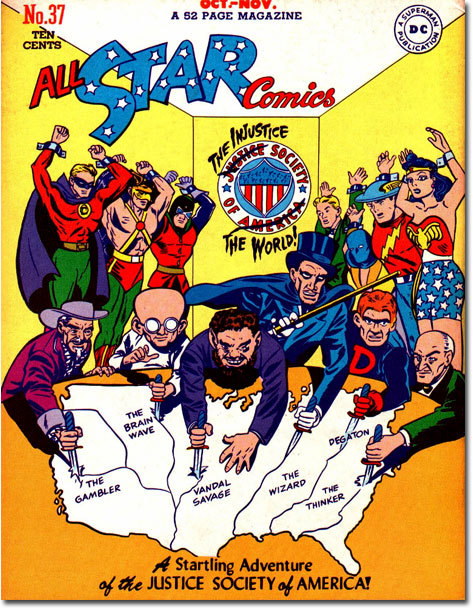
1947, Apr, All-Star Comics #34 – The Wizard
1947, Jun, All-Star Comics #35 – Per Degaton
1947, Oct, All-Star Comics #37 – Injustice Society of the World 
1948, Dec, All-Star Comics #44 – Evil Star
1951, Mar, All-Star Comics #57 – The Key
1999, Dec, Secret Origins of Super-Villains 80-Page Giant #1 – Johnny Sorrow

Hawkman
1940, Jan, Flash Comics #1 – Hath Set
1940, Fall, All-Star Comics #2 - Nyola
1941, Jan, Flash Comics #13 – Satana
1945, Apr, Flash Comics #64 – The Monocle
1947, Oct, Flash Comics #88 – The Gentleman Ghost


Plastic Man
1950, May, Plastic Man #23 – The Figure
1950, Sep, Plastic Man #25 – Mr. Aqua

The Spectre
1940, May, More Fun Comics #55 –  Zor
1940, Win, All-Star Comics #3 – Oom

Aquaman
1941, Dec, More Fun Comics #74, Blackjack

Green Arrow
1946, Sep, World's Finest #24 – Bulls-Eye

Dr. Mid-Nite
1947, Feb, All-American Coics #82 - Dr. Light

Starman
1941, May, Adventure Comics #62 – The Light
1941, Oct, Adventure Comics #67 – The Mist

Vigilante
1941, Win, Leading Comics #1 – The Dummy

Zatara
1938, Apr, Action Comics #1 – The Tigress
1938, Oct, Action Comics #5 – Amen-Hotep

Congo Bill
1940, Jun, More Fun Comics #56 - The Skull

Robotman
1943, Feb, Star-Spangled Comics #17 – The Turtle

Wildcat
1943, Ago, Sensation Comics #20 – Yellow Wasp
1947, Ago, Sensation Comics #68 – The Huntress

Sandman
1942, Sum, World’s Finest Comics #6  - Ramulus

Boy Commandos
1946, Jun, Boy Commandos #15 – Crazy Quilt


RELATED ARTICLES:


Wednesday, July 4, 2012

Know your Justice Leaguer


In a previous article, I made the personality profile of The Elongated Man. Knowing what makes a character tick is what makes them interesting. The bad (or the badass) seems to be the flavor of the day since the late 80s. Everybody needed to be like Rorschach, Batman or Wolverine to be cool. But that’s not good writing, just selling fool-proof hooks that can be pulled even by the lesser writers.
Good writers know how play with personality traits in order to sell any character. Take Lord of the Rings: The Two Towers, as instance, Tolkien and Jackson, managed to make a pop cult icon out of Gollum, a petty worm who is the very antithesis of any type of alpha male. The most read book of all times is about a loon that sees windmills as villains. The most popular sitcom is about four neurotic misfits… The trick is to know the character and to know how to exploit his personality traits.
With that in mind, I give you a list of sketches the most notorious members of the Justice League. My focus is on temperament, which I consider the very core of a person’s attitude.


Aquaman: His personality has wildly changed in some media; however, in comics, he’s most commonly portrayed as a tough yet melancholic, no-nonsense guy with a lot of weight over his shoulders. That crown is heavy.
He has an old soul. Like Batman, his eye for detail is just as sharp as his eye for the big picture. He’s extremely loyal and noble, but he doesn’t waste time on lost causes.
Within the League he sits among the other "kings": Batman, Superman, Wonder Woman and the Martian Manhunter. I just happens.
Other versions have him as a merrier guy. Batman: The Brave and the Bold even gave him a loud, bigger than life personality, very similar to the Thor of the 2011 movie. It’s not the original deal, but I kind of like this better, even if toned down a bit.

The Atom: It is ironic, but the smallest man alive, often feels like a small man inside. Despite being a genius and having one of the greatest super powers, he tends to feel guilty and undeserving, making him the most typically melancholic member of the team. He’s very creative and escapes everyday life through science and superheroics. He pulled the whole superhero thing for a woman, who doesn’t seem to appreciate him that well, which doesn’t speak well of his self-esteem. Hawkman, his best friend is also bossy and overly confident. The second he gets out of his lab, Ray Palmer tends to give a lot, expecting nothing in return.
He loves his role as the idea guy of the JLA, he's no tactician, but when it comes to tehnical matters, hes the go-to guy.
However, he is sometimes portrayed as an absent-minded genius with little interests outside science; your average Egon Spengler, Gyro Gearloose or Mr. Fantastic.


Batman: A compulsive melancholic who is obsessed with perfection. Fueled by survivor’s guilt, makes sure he’s the best at everything he does, including being the ultimate alpha. He’s very methodical and needs to control people and information alike. Years of practice have made him faster when it comes to acquiring new skills. He is able to act like a very social person as Bruce Wayne, but that’s all it is, an act. He has deep trust issues and can’t communicate affection properly to his loved ones (even though he is not that bad at hinting it). His most significant love affair is with Catwoman, who is just as distant in her own way. 
Working with the JLA, he arrives late at the Watchtower, takes charge, solve the problem and goes back to Gotham.
During the silver age, both as Batman and as Bruce, he was more civic-minded, polite and preachy. This characterization was reused with some added coolness in 
Batman: The Brave and the Bold.

Black Canary: She’s an overachiever, focusing all her dedication and discipline in continuing her mother’s legacy as a superhero. Mother issues and poor taste in men are perhaps the biggest aspects of her personal life. Opposed to Green Arrow, she’s also a strong, independent woman with feminist values. She works her ass off; Hal would just get the job done right with the best  tool available, and then hit the bar; by contrast, Dinah would do hours of exhaustive practice, almost as intensively as Batman. She plays hard to get, but she is no Catwoman. Ollie is her weakness; she demands a lot of herself only to fall for the resident ladies man. Her temperament is a bit melancholic, but phlegmatic enough to have great people skills, which makes her a perfect field leader.

The Elongated Man: The guy is all about doing what he loves and getting some attention while he’s there, by far, the most laid back out of the classic leaguers; a perfectly sanguine type. He’s quite diligent but wastes no extra energy to get the job done; he’s so practical that in his debut, he proved to be a faster crime-solver than Flash himself. He can solve anything Batman does – only with fewer resources and more lateral thinking. He's often the one who humbly presents a practical solution when the team seems to be up against the wall (even more often when Batman is not around). 
Out of the entire league, he’s the one that makes the most assertive life-choices and avoids drama the best. Ralph is a fun guy who managed to get the money, the girl, the fame and the status on his first day and then saves the world merely by “stretching at the right time”.

Firestorm: Ronnie is frat guy with a heart of gold. Being analytic never worked for him, so he focused on fun and what makes a male kid popular, but then, he got a challenge and was forced to change his ways. His fusion with Professor Martin Stein is like a permanent, intensive and forced mentorship that forces him to overcome that one aspect of his life he used to neglect. The way he acts, he looks self-secure, yet, he’s overcompensating for his lack of intellectuality, which he is overcoming as Firestorm. The JLA became even more reinforcement. Starting with Superman, they believe in his potential. He's the rookie of the team and when it came to fitting in, Ralph often took him under his wing.  


The Flash: One of the hardest to define for many people. He’s all about diligence and a huge sense of civic duty. His temperament is somewhere between phlegmatic and melancholic. He feels the need to complete great task and to do it step by step and by the book, often missing the forest for the tree. However, he can still be very creative. He’s very similar to Superman, only less bold, more humble and more of a side thinker. And while Clark pretends to be boring, Barry is the genuine article.

Green Arrow: This one is all about character. He’s sanguine like Hal, only with a shorter temper, savvier and more stubborn. He relies heavily on common sense and cynical observation to the point that he is perhaps the best judge of character in the League and, even though he’s about as old as the rest, he’s seen the “old devil” of the team. 
He was born with a silver spoon in his mouth, and yet, he’s so stubbornly liberal that he became the most socially aware JLAer; he’s the guy that often keeps the rest grounded. To him, watching out for the little guy is way more important than defeating the bad guy and his teammates appreciate him for that. That being said, he can also be patronizing, flawed and a bit chauvinistic. The fact that he’s an idealist doesn't mean that his behavior is perfect as a person, especially when it comes to women.

Green Lantern: The guy is the epitome of the charming alpha male. He likes, he takes. He shoots, he scores; very good at saving the day, getting the girl and having a great time. However, like a good sanguine (and unlike Ralph), he is not that great on the long term. Hal can’t keep the girl and doesn't really climb the job ladder, even when he has all the opportunities there. He probably feels a bit undeserving under all that cockiness.

Hawkman: He is a tough alpha male; nerves of steel, sharp, to the point; never misses a thing and he is always talking with authority. He never backs away from his frame. His views are often the toughest of the team. He and his wife might walk around bare-naked, yet he is very conservative (Republican in fact), overprotective with women (at least one time with Black Canary and often with his wife) and he takes the most aggressive stands on punishments.
As serious as Katar is, the ones that get close to him like Hawkgirl, the Atom and Elongated Man, can get him to show his lighter side.  That being said, he can’t stand Ollie.


Superman:  I always say, when your father treats you as if you were Superman, you end up flying. This is literally the case with Clark. He comes from two great sets of parents, the first gave them his genetic characteristics and the double gift of life and the second raised him as an assertive man with great values. He might feel the weight of the World when it comes to do the right thing with his powers (especially in the last decades), but classically, he does good because he truly likes and believes in kindness, Midwestern, all-American kindness.
The big difference with Barry, is that he is not as pressured by guilt, and that, as Clark, he only pretends to be a square. When it comes to Lois, he barely minds her aggressive exterior; he can only look at her great fiery heart.
In general, he’s easy going and calm. Modern interpretations have him more introspective, early ones had him self-righteous and the ones from the silver age, had him more easy going and even more chivalrous, with a slightly geeky sense of fun.

Wonder Woman: She is like Athena or King Solomon: graceful, merciful, assertive, proper, respectful, wise, kind and as self-secure as the archetypal good monarch. Generally calm and nice, she has no trouble being aggressive and taking the bull by its horns when the situation requires it. I would say that she is the best leader a team can have (keep in mind that leadership rotated in the original JLA).
With so many attributes everybody is in love with her; yet, she has something that prevents most from hitting on her. At some points she has been attracted to the idealist Superman, and at least an interpretation has had her with a thing for the more magnetic Batman; however, the guy that gets her heart (Steve Trevor)  is a suave gentleman with the right cause.

Zatanna: She is a crowd pleaser, loves the attention and manages to get that with her charming personality. Since she was created, there has always been constant drama on her life, she is always missing something, which tells me that she is a bit codependent. She’s mostly sanguine, having fun and going with the flow; however, she also has some supine and melancholic characteristics. Between the lines, I have noticed some daddy issues in her persona.


Did you like the character profiles? Here are some more:

Know your Super Buddy!
Blue Beetle, Booster Gold, Fire,  Ice, Sue, 
Maxwell and the rest of the late 80s gang!

Know your Bat-Villain! Part I - 
Probably the craziest supervillains in 
American comics, so it is a longer read.