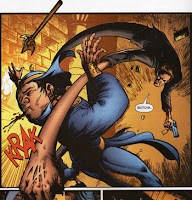
Over his 51 years of existence, the Elongated Man has worked cases along with some of the DC Universe's most notorious detectives: Batman, Slam Bradley, two of the Robins, the Martian Manhunter, and the members of the Croatoan Society (Detective Chimp, Dr. 13, Tim Trench and Edogawa Sangaku); not to mention the Flash and even Superman, who are investigators as Barry Allen and Clark Kent. The legendary Sherlock Holmes has already met Ralph twice, first in the 80s as an old man, and then in the 19th Century in his prime. In another interesting adventure, Ralph and Sue, both big detective fiction buffs, solved the mystery surrounding the death of Edgar Allan Poe. Therefore, it's safe to say that detective crossovers is definitively a thing when it comes to Ralph Dibny. The question is, should it stop there? Hell no. As a ghost, resurrected or set in the past, the Elongated Man and wife should get to meet as many sleuths as possible. It's only logical for a rich couple that travels around solving mysteries. This is why I made a list of the top 20 detectives the Elongated man should cross magnifying glasses with.
My rationale for the rank is simple, I just tried to level historical and current popularity with the chemistry and dynamic that they would have with the Dibnys (in other words, I pretty much did whatever I wanted). Let's consider their personalities first: Ralph is a very polite and nice Midwesterner, turned entertainer, turned her/socialite. As a detective, he has sharp eye for order, his main leads come from the crime scenes and he's quick to spot the extraordinary. His elastic powers serve him to spy suspects and infiltrate locations. His memory and ability to reconstruct scenes are sharp even under dramatic stress. Sue shares his wit and love for humor. In the classic stories she was just a spoiled wife and a compulsive shopper, but as time passed, she started getting into research. Her computer skills and experience coordinating the Justice League of Europe made her capable of hacking a satellite. She also became a successful detective fiction writer and developed a lot of creativity as a sleuth.
So, without further ado, here's the list:
27. Inspector Gadget
Created by Andy Heyward, Jean Chalopin and Bruno Bianchi.
Gadget is way too silly; even for a guy who made a super serum for elasticity out of a soft drink. This goofy cyborg is the wost detective ever. At least Clouseau is right on the money with his idiotic theories. I might as well have included Daffy Duck playing detective. However, I'll admit that the 80s kid in me thinks that it might be fun to see Ralph and Sue being forced to play the roles of Brain and Penny against a MAD that is somehow a serious thread, but it would rather have to happen in Gadgets universe.
26. Nancy Drew
Created by Edward Stratemeyer.
She’s a graceful, attractive, brilliant, overachieving and almost flawless teenage amateur sleuth. Gourmet cook, expert driver, great sailor, good painter and French speaker; Nancy Drew is a renaissance girl. She’s as multitalented as the Dibnys and just as nosy, if she was hedonistic like them, she’d be the daughter of their dreams. I think Sue would have a great time solving a “where’s the Elongated Man” mystery with her.
25. The Hardy Boys
Created by Edward Stratemeyer.
Frank and Joe Hardy are the stereotypical ideal of WASP kids. They play popular sports, get very good grades at school, have a regular group of friends and have pretty girlfriends. That’s the part that is supposed to make most people identify with them; the part that gets them interesting is that their old man is a talented detective and they get to imitate him without having formal training. An interesting side of them is that they often question the authorities and show a bit of a cynical attitude. I don’t think the Elongated man would let the m help him solve a case, but they are not the type that take a no for an answer, especially if they get to find out something he missed.
24. Angel and the Ape
Created by E. Neldon Bridwell.
Angel O'Day is like a slutty version of Sue and Ralph rolled into one; a talented detective with great fighting skills and a weakness for clothes and hedonism. Sam Simeon is also a good detective, but he plays 'the Watson' by being the silent bodyguard type. That's a lot of potential chemistry. Ralph would probably play the mentor to this surprisingly talented duo. I think that a team-up between the four should happen in an Angel and the Ape series, so that the story can have its characteristic zany humor.
23. Magnum, P.I.
Created by Donald P. Bellisario and Glen A. Larson.
Thomas Sullivan Magnum IV is the slacker of this crowd. Like Ralph, he lives an ideal life, even if that's thanks to a benefactor putting the Hawaii mansion and the Ferrari 308 GTS. He's single, fun easygoing and quite the ladies man. However, thanks to his wits his contacts and military training (he's a former Navy SEAL), he's also the type who always gets the job done. When he accepts a gig, he takes his private investigation job quite serious. Above anything else, he relies on moving around and using contacts to gather information. This would leave plenty to do for Ralph and his deductions if they teamed-up.
22. Madolyn "Maddie" Hayes and David Addison
Created by Glenn Gordon Caron.
Two of the few detectives in the list that are not super geniuses or utter incompetents. Maddie Hayes is a former model turned detective agency owner and David Addison is an alleycat turned detective/alleycat. Maddie is very proper, naive and controlling while David is a fast-talking scam artists. There's already a link and a secret story between Moonlightning and the Elongated Man: Ralph has a gun that is evidence from the "Anselmo Case" that was never solved in that series (despite working on it the entire run). Consequently, it'd just be a matter of explaining how he ended up with that. Ralph and David could definitively have an interesting detective team dynamic while Sue gives romantic advise to Maddie.
21. Monk
Created by Andy Breckman.
Even though Adrian Monk has OCD, a number of impairing phobias and a personality that is completely different from Ralph Dibny, they both follow a very similar strategy to break cases; they both work spotting oddities in the crime scene and using their privileged memories to remember every detail about it. I think that a story with both would require them to work separately on the same case, maybe Monk disappears while working on a case and Ralph has to follow his steps with Natalie assisting him.
20. Lord Peter Wimsey
Created by Dorothy L. Sayers.
Lord Wimsey has a lot of common ground with Nick Charles and Ralph Dibny: he's a wealthy man who solves crimes instead of having a real job (and his wife is a detective fiction writer, just like Sue became). He's actually the original gentleman detective. On the surface, Lord Wimsey would seem like Bertie Wooster playing amateur detective; however, he's more like Bruce Wayne investigating without the tights. Despite his self indulgence with pleasures and hobbies, he has a hero complex (and some PTSD issues) and tends to use his skills to help people in need. It might be interesting to see Ralph and him work the same case in parallel, each in his time.
19. Batgirl
Created by Gardner Fox and Carmine Infantino.
Barbara Gordon a.k.a. Batgirl pretty much works as a better version of Sue. Like Ralph, she has photographic memory; however, she prefers to rely on research and computer espionage like Sue. Maybe it was Batgirl who got Sue started with the whole hacker thing. That would be an interesting story to see.
18. Father Brown
Created by G. K. Chesterton.
Father Brown and Ralph Dibny have both very contrasting methods and personality. Brown is quiet and profound, Dibny is extroverted and irreverent. While the Padre relies on intuition, knowledge of human nature and borrows a some ratiocination from Dupin; the E-man is all deduction, observation. However, they both tend to find rational solutions to what appears to be supernatural. Put them in the same mystery and the story writes itself.
17. Agents Fox Mulder and Dana Scully of the FBI
Created by Chris Carter.
Mulder is a believer and Scully is a skeptic, they practically invented those words. They are good detectives, but not in the league of some of the sleuths of this list, which is good: Ralph puts the brilliant mind and they put the X-file. Although he knows supernatural first hand, in the classic stories had a tendency to be skeptical like Dana.
16. Harvey Bullock
Created by Archie Goodwin (not that Archie).
Lt. Harvey Bullock is not a solo flier, and he's not that impressive as a detective (actually, he's one of the less talented of the list), but this loud fowl-mouthed, clumsy, stinky, rude, stubborn, cigar-smoking, doughnut-eater, would make an excellent odd couple with the Elongated Man (I think Sue would bail on them after one minute of smelling Bullock). Ralph is easy-going, but I bet that the Fred Flintstone of the Gotham City Police Department can put that to the test.
15. Jessica Fletcher
Created by Peter S. Fischer, Richard Levinson, William Link.
I think that, by now, unlikable people with lots of enemies should have learned to get the hell away when she visits. Jessica is a strong, independent widow who used to be an English teacher and now writes mystery novels; your average nice grandma. She’s very neat and organized with her life; however, every time an acquaintance of her gets killed (and that happens incredibly often), she has the habit of making time to get involved and discover the murderer. She’s very charismatic and it is easy to relate to her; consequently, her method relies heavily on getting to know the people involved; normally, in a casual manner. Her conferences and conventions would easily have her crossing paths with Ralph and specially Sue, which would probably mean that a recently introduced unpleasant character will get murdered. The great thing is that she and the Elongated Man have very compatible methods.
14. Scooby-Doo and the Mystery Machine gang
Created by Joe Ruby and Ken Spears.
The idea is silly, and it would have to take place outside the DCU, but Scooby-Doo is a very recognizable pop-cult icon and, hey, if it's good enough for Batman, Vincent Price and Weird Al Yankovic, it's good enough for Ralph. I can almost hear Fred saying "Hey, it's Ralph Dibny, the World-famous Elongated Man". The story would probably have Ralph making an early cameo investigating a more case in the same town, then he would appear at the end revealing the identity of the villain, which was somebody related to his case, and finally, Wilma would reveal how the cases are related.
13. Charlie Chan
Created by Earl Derr Biggers.
Charlie is quiet, humble and wise. He always talks in proverbs and is very discrete. When he’s looking for a culprit, he’s main strategy is patience; he’s very observant and astute, often tricking the villain into incriminating himself or giving a lead away. There isn’t a Charlie Chan postmodern makeover yet (what is Jackie Chan waiting?), but as classically portrayed, he has a lot of personality and method contrast with the Elongated Man, which makes them ideal for an action/mystery buddy comedy.
12. Perry Mason
Created by Erle Stanley Gardner.
Perry Mason is as passionate in the court room as the Elongated Man is in the crime scene. True vocation men. They both love difficult cases to solve and they both had an extraordinary knack to tell when something is wrong. In Perry’s case, that’s when he picks a client; he never fails to recognize the wrongly accused and expose the true culprit. In order for both of them to shine, Ralph would have to be wrongly incarcerated and Perry would have to rely in the sleuth’s photographic memory to get his leads.
11. Miss Marple
Created by Agatha Christie.
Jane Marple is gossipy, nosy, adventurous and difficult to intimidate; however, she's also a kind and nice upper class old lady who likes to play the amateur detective, so, whatever she doesn't have in common with Ralph, she does with Sue. Given her old age, I could perfectly see her requesting the assistance of Mr. and Mrs. Elongated Man. While she's not afraid of danger, at her age in her later books, she would benefit a lot from a super detective with stretching powers (normally used to spy). Her cynical attitude towards human nature would be a nice contrast with the stretchable sleuth.
10. Le Chevalier C. Auguste Dupin
Created by Edgar Allan Poe.
This guy is the father of all gentlemen detectives, and Ralph knows it. Papa Dupin is practically a rational machine who likes to free himself of all human emotion. His main method is called “ratiocination”, and consist on putting himself in the mind of the criminal. Ralph would love meeting him, although after an adventure together, he’d feel sorry for the guy. While the he’s an assertive man who got everything he wanted from life really soon (fame, wealth, love, his perfect career, JLA membership), Dupin’s family lost their fortune and he ended up being a lonely snob who denies human experiences to himself. I can’t help but imagine him portrayed by Jim Parsons as a Victorian Sheldon Cooper (from The Big Bang Theory).
9. The Inspector
Created by Blake Edwards.
Chief Inspector Jacques Clouseau is famous detective, yet not a talented one. Despite being highly incompetent, I think the Ralph could make sense out of one of his ridiculous theories (which are usually right) and help him to crack a case. As long as they don't make him the butt of the jokes, the Elongated Man mixes well with comedy, and Clouseau could get him in pretty funny situations. If some nut actually made such story, he should create a prologue short story sequence with the Inspector and a brainwashed rogue Elongated Man (and a Pink Panther cameo) in cartoon style, establishing how the two meet.
8. House
Created by David Shore.
Who do you think would win a discussion the medical sultan of sarcasm or the super-heroic wonders of wit? House is mean and cynical, but the Dibnys are comeback experts; the three of them are quick and sharp judges of characters, so it would be an interesting situation. Ok, House is not really a formal detective, but are you really surprised to see him here? I think that a team-up between them would be very dynamic, since they both have very different areas of expertise.
7. The Question
Created by Steve Ditko.
The Question is definitively in Ralph and Batman's league, only he's more of a researcher and, in recent incarnations, a conspiracy nut (one that if always right). Like a lot of people I loved the Justice League Unlimited version; heavily influenced by Rorschach and Fox Mulder. Ralph is sharper in practical matters and crime scenes, but Vic has the edge on connections, which would create an interesting partner dynamic. A crossover would have the two of them alone, with Ralph playing the Scully to his Mulder.
6. Dirty Harry
Created by Harry and Rita Fink.
Inspector "Dirty" Harry Callahan in not precisely famous as a detective genius, and yet he always beats the rest of the San Francisco Police Department to find dangerous serial killers. The thing about him is that, as his name indicates, he's an antihero; he'll always manipulates the situation so that he has a good pretext to eliminate murderous criminals. This contrasts with Ralph, a happy laid back superhero who never uses lethal enforcement who is satisfied with cracking the case. It'd be fun if Ralph figured out that an old Harry is about to kill the wrong suspect.
5. Philip Marlowe
Created by Raymond Chandler.
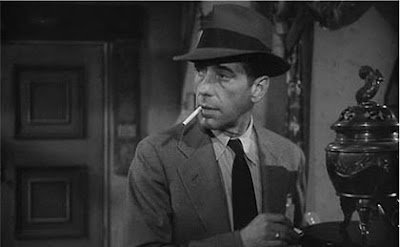
Great crossovers show contrast which is something that this hardboiled detective could definitively bring to the table. Like Ralph he’s wisecracker and a fast thinker, but he’s humor is dry and he’s a street-smart blue collar private dick depending on his latest gig to make a living. Ralph’s got it easy and lives in the utopic world he created for himself; Marlowe had to master the laws of the street to survive. Ralph is all about solving the mystery with his impressive deduction skills and spying super abilities, Philip has to investigate while adapting to crude realities in the process. They are also very different in their private life: the Elongated Man is a comedian and a showman who goes to his wife and enjoys an hedonistic socialite lifestyle with her; Marlowe is profound, lives alone (although he might get lucky) and enjoys chess, poetry and drinks. A team-up would also generate a very postmodern refry style, mixing hardboiled detective pulp with the superhero comic version of the stereotypical golden age of detective fiction tone.
4. Nero Wolfe
Created by Rex Stout.
When it comes to eccentric detectives, Nero Wolfe takes the price. He’s obese, extremely demanding and routinary, snobby, has a bad mood, a short temper, probably OCD. He’s wealthy yet he lives almost like a hermit in his brownstone house in Manhattan; which makes him conduct all his investigations in a Top Cat style from home, using Archie Good, his witty live-in detective assistant, as his contact with the outside. Nero mostly conducts interviews at his office and he’s extremely cautious controlling information. The easiest way to create an interesting dynamic would be having Ralph replacing a kidnapped Archie.
3. Hercule Poirot
Created by Agatha Christie.
Ralph would obviously consider this legendary guy an absolute eminence and it would be a honor to work with him... the first ten minutes. After that the Dibnys wouldn't be able to stand the arrogant, egocentric and unlikable man. Sue would want to strangle him! Poirot tends to rely on the interviews while Ralph is a lot more focused on physical clues. I think a collaboration story would have both brilliant men splitting very soon and coming together at the end to solve the crime.
Note: A Brave and the Bold story has Batman and the Elongated Man making reference to The A. B. C. Murders, a Poirot mystery. The murderer they were chasing was following a similar scheme.
2. Columbo
Created by Richard Levinson and William Link.
Ralph is actually older as a character; however, if these characters were put in the same world, I'm sure Lt. Columbo would be his biggest contemporary idol. Columbo is normally set against pretentious intellectuals or socialites, so it'd be fun to see him work with one for a change. Ralph would seem to do all the connections, but it would be the Lieutenant who would humbly close the final gaps. I'd love to see them brainstorming in Columbo's station until they figure a lead. Part of the appeal is that such crossover would have to come with a classic Columbo story structure, with the murderer revealed at the beginning, and the two detectives working the howddunit. Ralph would focus on gathering clues and spying while Columbo handles the interrogations, and they would use Ralph's elastic powers to set the villain.
1. Nick and Nora Charles
Created by Dashiell Hammet.
They are the inspiration for Ralph and Sue, so, naturally, the two couples would be dynamite together; like Dibny in stereo in front of a mirror. The main difference is that Nick gets his super powers from buzz and not from a Gingold elixir – Oh, and that instead of super elasticity and strength, his most notorious powers are lost of balance and poor driving. Both are extraordinarily talented detectives who stop the press when they get in town, they are both retired and work out of altruism and they are both married to beautiful socialites. The exchange of witty comments between those four would have to be almost as legendary as the partying and as fast as the bouncing of ideas that Nick and Ralph would have during their investigations. A barfight scene is obligatory and it wouldn't be a Thin Man if they don't gather all the suspects and people involved to reveal the murderer at the end.