Showing posts with label Flash. Show all posts

Saturday, October 28, 2017

10 common misconceptions about the Elongated Man


Finally! The Elongated Man is set to debut this Tuesday (October 31), and many fans of the show might want to know a little more about him. Googling him is easy enough, but with so many misconceptions spread online it's very easy to get the facts wrong.

For instance, Geek History Lesson podcast #184 got every possible fact wrong. Which goes to show us the limitations of the Internet as a source. So, I made a Steemit post about the most common misconceptions about Ralph. Click here to read it.

Why Steemit? Because that network allows us to get rewarded for every contribution we make as bloggers. So, if you like the content, please make sure you start an account there, upvote it, and create your own.

Here are two of the ten misconceptions:

10. "Identity Crisis and 52 are the best Elongated Man stories"


Those are some of the best stories with him, but not the best about him. Neither has a protagonist. In the first —which some fans even consider damaging for him as a DC property—,  he and Sue are plot devices and the mystery is solved by chance. In the second he gets a great case to solve, but that's one of six main plots of the series.

Showcase Presents the Elongated Man shows the character in his original spirit —imagine a 60s sitcom with Dick Van Dyke as a detective with super stretching. It compiles all of his early appearances in The Flash and his first 45 in Detective Comics, although it has no second volume and it leaves out anything published after January 1968.

A complete list of recommentations would have to include Detective Comics #500, 557 and Justice League Quarlerly #6, because....

7. "Sue always hung out with the League at the Watchtower"


Although it's a good one, the sad truth is that Sue didn't frequent the Watchtower. She started hanging out with the Justice League at the bunker during the Detroit years, and later again with the Justice League Europe at the Paris JLI Embasy (which they eventually moved to London). This takes us to...

Click here to read the other 8 misconceptions about the Elongated Man.

Saturday, July 23, 2016

Zack Snyder tweets the first Justice League trailer.


The bits in the trailer are visually similar to Batman v Superman, even with the bluish hue, yet the tome is very similar to that of a Marvel movie.

Snyder might have taken notes from his critics, besides the humor, and more joyful attitude of the characters, Ezra Miller looks a lot les like a slacker and more like the TV version.

It is also noteworthy that Bruce Wayne is the one recruiting other heroes, not Batman.

It is also noteworthy that the Elongated Man is not included in this movie. Well, no, that's comes without saying, but I noticed anyway.

Wednesday, June 1, 2016

The Rebirth Universe... Sounds like a good idea

Well... I don't see the recently restored Elongated Man in there, but I still have to tip my hat to Dan DiDio, Geoff Johns and the rest of the DC guys for this brilliant decision.

The next incarnation of the DC Multiverse seems to be a mix of the New 52 (or the "DCnU") with the pre-Flashpoint multiverse but with some improvements:

  • Legacy characters like Ryan Choi or Jaime Reyes work with their predecessors instead of replacing them out of the blue.
  • The original Teen Titans generation of sidekicks is restored, with a place for Wally and Donna.
  • The golden age superheroes are back and World War II is part of their history again.
  • Romance is back. Aquaman and Mera, and Lois and Clark are couples again.
  • Love, hope and optimism is allowed again. 

Personally, I think it's an excellent change.

The time might seem odd, but if the grimdarkness of the New 52 was damaging the properties, it was smart to cut it before it does worse.

Some people believe DC to distinguish itself from Marvel, by being "the dark one", but it has only been that way in recent years. Traditionally, DC covers all sorts of genres an tones: comedy, romance, western, war, dark, etc. It became darker as it started imitating the tone of stories like Watchmen or Batman: The Dark Knight Returns, rarely with the same level of success outside its Vertigo imprint.

DC's superheroes were more optimistic than Marvel's during the silver and golden age. Usually more assertive and civic minded. Romance and couplehood isn't new to them either. Hawkman and Hawkgirl marry very soon in every incarnation, the Elongated Man was married by his third appearance, Aquaman married in 1964, followed by the Flash and the Atom.

The Rebirth Universe sounds great. So, let's see where it goes.

Saturday, May 28, 2016

DC Universe: Rebirth #1 —Una carta de amor de Johns a la esperanza, el optimismo y el legado

Ya se publicó el primer número del DC Universe: Rebirth, y todo el mundo parece estar enamorado de él.

Rebirth es otra revisión a la continuidad del Universo DC. Es impulsada por la nostalgia, y amenaza con cometerle sacrilegio a la obra maestra y sacrosanta de Alan Moore... Pero con suficiente razón, fue bien recibido.
Rebirth en resumen.
El primer número, escrito por Geoff Johns, abre mostrando el mecanismo de un reloj que le pertenece al narrador. Es perfecto salvo por un solo engrane malo, que evita que el resto funcione. Al final,

—spoiler menor— 

se compone el engranaje. Esta metáfora es obvia: el Universo DC tiene un error (perdición, pecimismo y corte con el pasado), este primer capítulo promete arreglarlo, y empieza satisfaciendo una demanda de muchos fans. Esto es un posible presagio del final de Rebirth y de la forma en la que este cambiará el Universo DC.
Muérete de envidia, Miguel Ángel.
La continuidad que Rebirth critica se conoce como "Las Nuevas 52" o "el nuevo Universo DC" (DCnU, por sus siglas en inglés), fue creada en el 2011 tras la mini-serie Flashpoint. Como todas las continuidades anteriores, no se inició con los nuevos orígenes para cada personaje —estos vinieron después—, sino con nuevas historias que no dependen de un bagaje de años de continuidad. Resultó una eficiente introducción para muchos nuevos lectores, pero también un sacrificio de millones de páginas de la historia de DC.

Conforme fue revelado el pasado de "Las Nuevas 52" (o informalmente, el DCnU), lectores veteranos se enteraron de que muchos de sus personajes e historias favoritas nunca existieron. En las Nuevas 52 personajes como Wally West y Donna Troy no existen, las nuevas versiones de los personajes de la era dorada, como Jay Garrick o Alan Scott son demasiado diferentes y viven en una tierra paralela, el Martina Manhunter, el Hombre Elástico, y Zatanna nunca pertenecen a la Liga de la Justicia, Tim Drake apenas conoce a Batman, y así hay muchas situaciones. Además, todos los títulos perdieron la numeración que llevaban, algunos desde los años 30s. Para muchos lectores, el Nuevo 52 parecía ser negacionismo.
Una de las imágenes inaugurales de Las Nuevas 52.
Muchos fans también percibieron un exceso de violencia y pesimismo. Después de Flashpoint (2011, también por Geoff Johns), el primer número de Detective Comics muestra la cara del Joker arrancada, la primera Red Hood and the Outlaws muestra una Starfire sin recuerdos o amor por sus viejos amigos, el primer Batman muestra un psicópata versión de James Gordon Jr., y el primeros de Catwoman muestra una relación de Gatúblela con Batman meramente sexual sin emoción. Además, muchos matrimonios y relaciones de pareja (Luisa y Clark, Arthur y Mera, Ollie y Dinah, Dick y Kory) dejaron de existir.
Lo que está en juego en Rebirth.
Wally West narra la historia (esto no es spoiler, es claro desde las primeras páginas) y habla de toda la esperanza y el optimismo que se había perdido después de Flashpoint. No es que las cosas eran exactamente felices después de Crisis de Identidad (2004), pero la historia de DC todavía contaba. En Rebirth, la causa es recuperar el legado de DC.


Geoff Johns también hizo Crisis Infinita en 2005, que también se trata de la percepción de que el Universo DC es lugar oscuro y pesimista, solo que en esa historia el que quería devolver la esperanza y el optimismo, Superboy Prime, era el villano y una parodia de fanboys nostálgicos. En Flashpoint la nostalgia y el legado que se perciben y celebran como algo bueno, algo que los héroes quieren.

Claro, la identidad del villano de Rebirth es un meta-comentario sobre Watchmen (Alan Moore, 1986) y su influencia en los cómics de súperheroes. Esto deja interrogantes: ¿En verdad le echan la culpa del pesimismo y la violencia a Watchmen?, ¿mantendrán el punto de Watchmen intacto? ("entérese for el mismo baticanal, a la misma batihora"). Es demasiado pronto para pensar lo peor. Tratar con una franquicia tan respetada y sus personajes es una tarea compleja, veremos si Johns es capaz de manejarla.

Como un primer acto de la serie, ofrence adelantos de Ted Kord y Ray Palmer teniendo a Jaime Reyes y Ryan Choi como sus protegidos en lugar de sus remplazos, así como la promesa de regresar a los héroes de la era dorada y las relaciones amorosas. Eso es lo que está en juego en esta serie.

Como una historia Rebirth está bien. Como sucede usualmente en las historias de Johns hay mucho énfasis en los asuntos de padre e hijo, en lo que el narrador recuerda o completamente feliz o completamente trágico, o de como los chicos con el corazón en el lugar correcto superan a bullies estereotipados (en EEUU les llaman bullies de los "after school specials" de la TV).

DC Universe: Rebirth #1 no es una obra maestra Mooreana, sino un hit eficiente con muchas probadas y in esperado mensaje editorial de optimismo y esperanza. Finciona bien como una historia, pero excelente como una declaración de misión.
Esperanza, optimismo y legado.

DC Universe: Rebirth #1 —Johns's love letter to hope, optimism, and legacy

The first issue of DC Universe: Rebirth is out, and everybody seems to be in love with it. It is yet another revision to the DC Universe continuity, it is driven by nostalgia, and it threatens to commit sacrilege to the most sacrosanct masterpiece of Alan Moore... But with good reason, it was well received.
Rebirth in a nutshell.
The issue, written by Geoff Johns, opens by showing a perfectly good watch clockwork with one bad gear preventing it from working. By the end,

—minor spoiler— 

the gear is fixed. This metaphor is a no-brainer: the DC Universe is all wrong. This first chapter promises to fix the DC Universe and starts by satisfying a demand of many long time fans; more hope and optimism. The metaphor works as a possible presage to the way this series will change the DC Universe.
The Renaissance of the DC Universe.
The narrator of Rebirth criticizes the continuity created in 2011, officially called the New 52 and created after the Flashpoint mini-series. Like all previous continuities, it didn't start with the new origins of each character —those came later—, but with new stories that didn't rely on a baggage of previous stories. It was an efficient introduction for many new readers, but a sacrifice of millions of pages of DC history.

As the past of this new "the New 52" continuity was revealed, long time readers learned that many of their favorite characters and storylines never happened. In the New 52 multiverse sidekicks like Wally West and Donna Troy don't exist, the new versions of the golden age characters like Jay Garrick or Alan Scott are way too different, the Martina Manhunter, the Elongated Man, and Zatanna never belong to the Justice League, Tim Drake barely knows Batman, and so on. Furthermore, all titles lost their numbering, even those that started it in the 1930s. For many readers, the New 52 seemed to be denialism.
One of the inaugural images of the New 52.
Another perceived problem was the excess of violence and pessimism. After Flashpoint (2011, also by Geoff Johns), the first issue of Detective Comics shows the face of the Joker peeled off, the first Red Hood and the Outlaws shows a Starfire with no memoríes or emotional attachment, the first Batman shows a psychopath version of James Gordon Jr. And along with that, many marriages and love relationships (Arthur and Mera, Lois and Clark, Ollie and Dinah) ceased to exist.
This is what is at stake in Rebirth.
Wally West narrates the story (no spoiler there) and he talks about all the hope and optimism that was lost after Flashpoint. Not that things were exactly happy after Identity Crisis (2004), but all the previous DC history was still there. In Rebirth, the cause is recovering DC's legacy.

Geoff Johns also did Infinite Crisis in 2005, which is also about the perception of the DC Universe as a pessimistic dark place, only that time the guy who wanted to restore hope and optimism, Superboy Prime, was the villain and a parody of nostalgic fanboys. In Flashpoint nostalgia and legacy is perceived and celebrated as a good thing, something that the heroes want.

The identity of the antagonist of the story, of course, is a meta-commentary on Watchmen (Alan Moore, 1986) and it's influence on comics. This raises many questions. Is the story actually blaming the pessimism on it? Will Rebirth keep the point of Watchmen? This seems like a cliffhanger of the 1966 Batman show ("Tune in tomorrow. Same Bat-time, same Bat-channel, same Bat-peril") with Watchmen in Geoff's trap, but it's too soon to think negatively. Dealing with that franchise and its characters is a complex task, we will see if Johns is able to pull it in the upcoming issues.

 As a first act, it offers previews of Ted Kord and Ray Palmer having Jaime Reyes and Ryan Choi as their protegees instead of their replacements, as well as a promise to bring back the golden-agers, and love relationships. This is what is at stake for the rest of the series.

As a story it is fine. As it usually happens in Johns's stories there is a lot of emphasis on father-and-son issues, on the stuff that heroes remember as absolutely great or terribly tragic, and on how they have their hearts in the right place and they overcome after school special bullies.

DC Universe: Rebirth #1 isn't a Moorean masterpiece, but an effective hit with lots of teasing and a long expected editorial message of optimism and hope. It works fine as a story but excellent as a mission statement.
Hope, optimism and legacy.


Thursday, May 14, 2015

The 6 Birthday Mysteries of the Elongated Man


"The Elongated Man's Other-Worldly Wife" (Detective Comics #332) started one of the earlier traditions of the Dibny: The birthday mysteries.Every year, around Ralph's birthday, March 21, Sue prepares a mystery for him to solve. She does so many of those that, at some point, the Daily Planet runs an entire section on them.

Some of his partners in crime include the Sue's uncle Jim, Flash, Green Lantern, Alfred Pennyworth, the entire Justice League International and his last was going to be Green Arrow.

Since Ralph turned 55 on Tuesday, in order to keep the celebration going, I decided to make the list of birthday mystery stories.

BIRTHDAY MYSTERY I

Detective Comics #332 (October 1964), "The Elongated Man's Other-Worldly Wife" - Ralph discovers that Sue is the beautiful leader of an alien invasion. Written by Gardner Fox, with art by Carmine Infantino and Sid Greene.
This is the one that started the tradition. Epic art, Carmine is the master of design Sue looks incredible as an alien queen. This is by far, her most elaborated scheme.

BIRTHDAY MYSTERY II

Detective Comics #350 (April 1966), "Green Lantern's Blackout" - Hal can't remember that he is the Green Lantern, so, since Ralph and Sue are in Coast City, Pieface recruits him to save the day.
This birthday Ralph got a very memorable present from Sue (and Paul Gambi?).
Written by 
Gardner Fox, with art by Carmine Infantino.
Somehow, this one has a dark feeling, a bit hardboiled for an Elongated Man story.


BIRTHDAY MYSTERY III

Detective Comics #375 (May 1968), "The Face That Stopped Clocks" - In Wayside City, a man can stop clocks by staring that them. Even though Ralph is expecting Sue's mystery and his nose doesn't twitch, he agrees with her to follow him. 
Written by Gardner Fox, with art by  Mike Sekowsky and George Roussos.
Out of all the DC superheroes of the 60s, the Elongated Man feels the most like a sitcom of that era. This story is just like watching Bewitched, The Dick Van Dike Show or My Favorite Martian. 

BIRTHDAY MYSTERY IV

Detective Comics #449 (July 1975), "The Mystery Man Who Walked On Air" - Sue spots an old man walking on air outside their hotel room in Key West, FL.
Written by 
Mary Skrenes, with art by Dick Giordano.
I don't know if its the 70s, or the "old man", but the only thing missing is a scary monster to make it a Scooby Doo story.

BIRTHDAY MYSTERY V


Justice League Quarterly #6 (January 1, 1992), "Take My Wife--Please!" - Sue goes missing in Seaside City and the Ralph gets help from the Justice League International to find her.
Written by Mark Waid, with art by Eduardo Barreto, this is often considered the best birthday mystery by fans. Personally, I have to agree; this one feels like Ralph and Sue take the JLI gang on a roller coaster of mystery, keeping both the Giffen-DeMatteis line of humor and the silver age vibe of the Elongated Man stories. 
Ralph is perhaps the only silver age superhero that kept his mid-60s spirit, this feels like a celebration of that.

BIRTHDAY MYSTERY VI


Identity Crisis #1 (June, 2004) - "Chapter One: Coffin" - Ralph thinks Sue is only going to get him a magnifying glass he saw in Belgium, but at their Opal City home, she has a bigger surprise and a mystery set with Green Arrow on board... We end on a sad note...Written by Brad Meltzer, with art by Rags Morales.
It's controversial... I'm not touching that one with a 60-feet pole.

And that was the last one. Hopefully, the new DC horizon will bring us many more.


THE END

OR IS IT? (Update: 06-30-2015)

Nope, it wasn't. And that's great news.

BIRTHDAY MYSTERY VII (or VI b)


The pic is from Justice League 3000 #12 (feb 2015), and it shows the Blue Beetle and Booster Gold of what I like to call "Earth-Bwah-Ha-Ha" (hey, the term kind of got a blog laugh from J.M. DeMatteis), a continuity in which the events after I Can't Believe It's Not The Justice League are completely different from what was published by DC. This means that Identity Crisis, Countdown, 52 and all the stories that turned the lives of Ralph and Sue, along characters like Maxwell Lord, Blue Beetle and Rocket Red into deaths and tragedies didn't happen. Instead, we get a number of extra birthday mysteries for Ralph, including the one Blue Beetle is talking about in the picture.  

In this continuity, sometime after the events of  I Can't Believe It's Not The Justice League, Blue Beetle and Booster Gold, disappear when the Super Buddies were having a surprise party for Ralph and wake up some 3000 years in the future. This means that, although they didn't plan it, their disappearance became the 7th published birthday mystery, and, since Ralph obviously didn't find them, we can assume it's the only one he never solved... 

Tuesday, May 12, 2015

HAPPY 55th BIRTHDAY, RALPH!


Actually, according to Mark Waid's excellent Justice League Quarterly #6, that's on March 21 (along with Dick Grayson). However, the date on the cover of The Flash vol. 1, #112, his debut issue, is May 12, 1960, which means that the character is 55 years old. He could be my old man!


Ralph was created by editor Julie Schwartz as a supporting character for the Flash. Legend has it, that he would have been named "Plastic Man" if his creator, the legen-- wait for it... dary editor Julie Schwartz knew DC had the rights to that name. Which makes sense, since he liked to make new characters with old names.

At first, only after Iris herself, he was one of the most recurring character in the pages of The Flash. He met the Flash, saved the world from a number of alien invasions, got married to Sue, gave away his secret identity, met Kid Flash and fought some rogues. However, after a while, he moved with his wife to the pages of Detective Comics, where they became comic book versions of Nick and Nora Charles, traveling throughout US and the world in a convertible and solving mysteries in every town. 


In his first appearance, his detective skills were so fine that Flash couldn't beat him up to the crime scenes.
They both had to share the "man of the year award".
Left: Eventually. Ralph got his own adventures in the pages of Detective Comics.

Some time later he joined the Justice League of America, which later became the Justice League International.


Ralph and the Justice League of America.

Ralph and Sue with the Justice League International.

Some of his best accomplishments include solving the murder mystery of Edgar Allan Poe, teaming up with the Flash to prevent 3 alien invasions, defeating the Felix Faust and Neron team-up, becoming one of the earliest members of the Justice League and teaming up with Batman, Robin, Slam Bradley and Sherlock Holmes to fight Edgar Moriarty.


Unlike most superheroes, Ralph makes his own luck. He created his own super powers by formulating the "Gingo elixir", from the extract of an indigenous fruit from the Yucatan Peninsula (ie, "made in Mexico"). He also trained himself until he became one of the best detectives of the world, made a fortune as an entertainer and married a beautiful girl from New York's high society. He is also a close friend of DC's best, from Clark Kent to Ted Kord, he knows them all.

Another big difference with most superheroes is that Ralph is laid back and a bit of a class clown. Oddly enough, his humor tends to come from his observations rather than his making odd shapes with his body; if Plastic Man is Jerry Lewis, the Elongated Man is Jerry Seinfeld. This takes after Nick Charles, and as in his case, humor is just a side of Ralph's sharp mind. When he is not solving mysteries he is learning languages, like French, Interlac or Kryptonian.

Ralph and Carter are about to get busted by Wonder Woman.

One of the earlier traditions of the Ralph Dibny mythos (since "The Elongated Man's Other-Worldly Wife", Detective Comics #332) is that around his birthday Sue would prepare a mystery for him to solve. She has done so many of those that the Daily Planet ran an entire section on them. Some of his partners in crime include the Flash, Green Lantern, Alfred Pennyworth, the entire Justice League International and his last was going to be Green Arrow. (
For more information about Ralph's "birthday mysteries", click here). 

And it looks like DC is giving him a birthday mystery. Just like Sue not right on his birthday, but around it, as we have the 
Convergence: Justice League of America story going on.


They are back!


I wish a nice come back for my all-time favorite DC character. 


For more information about Ralph's "birthday mysteries", click here. 

Sunday, July 6, 2014

The Periodic Table of Superheroes

It's funny how as awesome as it is I can't help but nitpick minor details. Like The Atom, Speedy and Mr. Mxyzptlk so notoriously missing. They were popular during that era, as well as Cyborg, Starfire, Raven and Beastboy. Harley has nothing to do there (although, retroactively, it would have been a really cool thing to see), and I feel that the Scarecrow, Captain Cold, Grodd, Black Manta, Zod, Solomon Grundy, Sinestro, Sivana, Mr. Mind and Mordru were more popular than Two-Face. That being said, we have to note that whoever did this grouped heroes by families, which wouldn't have made easy to fit everyone there. It's fun to play with these ideas, anyway.

Monday, September 16, 2013

New Elongated Articles

Hi, everyone,

I've been really busy with work and life in general, and it seems that the situation is going to stay like that for a long while. Luckily, other bloggers have not forgotten about Ralph and Sue.

WTF, DC? Elongated Man/Digital Comics


Whoever writes WTF, DC?  decided to do a nice recap of the Dibny tragedies and their current status. A pretty neat job; the auhor nailed all the highlights and reminded us that DC still owes us an explanation: Why?

Why indeed.
Perhaps that was intended as a saga that never materialized. Perhaps TPTW were not Dibny fans. We're unlikely to get to know now.

I agree that Identity Crisis put the Dibnys on the map. And that was front and center in a way that I don't think they have ever been. Barry went with a bang on Crisis on Infinite Earths, Hal did the same on Zero Hour and somehow, the JLI's comic relief got his moment as well. After that, Blue Beetle II, and Booster Gold followed. However, despite the peak moments of fame that those stories provided for their protagonists, they normally don't sit well with their fans, which is why Barry and Hal eventually returned and why people like the author of WTF, DC? still expect the return of Ralph, Sue and Ted in the New 52.

If I had to do some constructive criticism on the article, I'd say it needs to go back a bit more, before JLI, when Ralph became mostly comic relief. His past as supporting cast of Flash, mystery solver and the idea guy of the JLA (mostly after Batman left) could have been mentioned.

DC Couples

Here's an interesting pick of four of the most iconic and solid DC couples.

As far as I can track it's origin, the original poster of this image seems to be Mecha Rebekah, from Tumblr. Maybe she drew it too.

A bio thingy

Frank Diabolu just sent me this. He received it from Shag. Further than that, which is not much, I have no idea of its origins. Enjoy it, anyway.


25  characters still missing from the New 52

And finally, here's a list of characters that still need to return in the new DC continuity. After even Year One has gone out the window, the common opinion seems to be that the new Ralph and Sue should just pop up with a somewhat clean story. I insist, detective fiction sells greatly on TV and books, so, it should do fine in comics (more so now that DC has no couples).

Friday, April 5, 2013

Carmine Infantino dies.

To the world of comics it can be said that a legend passed; to the world of the Elongated Man and Flash it must be said that the legend, Carmine Infantino, passed away at age 87.

He created the Elongated Man, Sue Dibny, Flash, the Rogues, Grodd, Batgirl, Animal Man, King Faraday, Pow Wow Smith, Detective Chimp, Black Canary and Captain Comet, and contribute to Adam Strange and the first Flash, and revamped Batman during the 60s. As you can appreciate, one can't possibly think of silver age without getting mental images of his art. Not only he was prolific, but his style truly capture the style of his era. As an architect, seeing his interpretations of modern an googie architecture is quite an experience. And the same goes for fashion enthusiasts. I didn't live through the 60s, but no artist gets the vibe of the shows and movies of era like Carmine.

R.I.P.

Since the experts teach best, here's some Infantino 101 from the master Ty Templeton: http://tytempletonart.wordpress.com/2013/04/05/carmine-infantino-and-roger-ebert/

Wednesday, July 25, 2012

The Golden Age chronology!

For no particular reason (well, there's one, but you don't get to know about it for a while), I'm posting a chronological list of the debuts of the golden age characters of DC.


1935
Oct, More Fun Comics #6 – Dr. Occult, Rose Psychic

1937 

March, Detective Comics #1 – Slam Bradley and Shorty Morgan

1938 


Apr, Action Comics #1 – Superman, Zatara, Tex Thopson
Oct, Detective Comics #20 - Crimson Avenger and Wing

1939 
May, Detective Comics #27 – Batman
Jul, Adventure Comics #40 - Sandman


1940
Jan, Flash Comics #1 – Flash, Hawkman, Hawkgirl, Johnny Thunder
Feb, More Fun Comics #52 – The Spectre
Mar, Adventure Comics #48 - Hourman
Spr, Batman #1 – Catwoman
Apr, Detective Comics #38 –  Robin
May, More Fun Comics #55 – Dr. Fate
Jun, More Fun Comics #56 - Congo Bill
Jul, All-American Comics #16 – Green Lantern
Oct, All-American Comics #19 – The Atom
Nov, All-American Comics #20 – Red Tornado
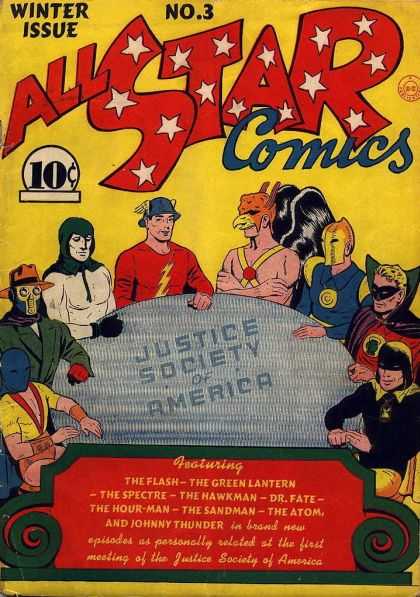
Win, All-Star Comics #3 – The Justice Society of America (Hawkman, Atom, Flash, Green Lantern, Dr. Fate, Spectre, Hurman and Sandman).

1941
Apr, All-American Comics #25 – Dr. Mid-Nite
Apr, Adventure Comics #61 - Starman
Sep, More Fun Comics #73 – Aquaman, Green Arrow, Speedy
Sep, Adventure Comics #66 – Shining Knight
Sep, Action Comics #40 – Star-Spanged Kid, Stripesy
Oct, All-Star Comics #8 - Wonder Woman
Oct, Star-Spangled Comics #1 - Tarantula
Nov, Action Comics #42 – Vigilante
Winter, Boy Commandos #1 – Liberty Belle
Winter, Leading Comics #1 – Seven Soldiers of Victory

1942
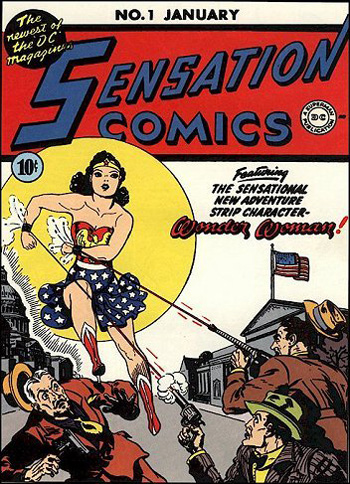
Jan, Sensation Comics #1 – Wildcat, Mr. Terrific
Feb, Detective Comics #60 – Air Wave
Apr, Star-Spangled Comics #7 – Robotman, TNT and Dan the Dyna-myte, The Guardian


1947
Aug, Flash Comics #86 – Black Canary

1948
Jun, - Star-Spangled Comics #81 – Gimmick Girl

1983
Jul, All-Star Squadron #23 – Amazing Man


Adoptive characters

A bunch of current DC Comics properties were created outside National Comics / All-American Publications. In this list I'm mixing Fawcett Comics, Quality Comics and Fox Comics. However, it must first  be considered that [besides the ancient and classic god pantheons and the biblical characters] certain classic characters that exist in the current DCU were created even before that:

c. 9th Century: King Arthur, Merlin, and the Knights of the Round Table
c. 1422: Robin Hood
1887: Sherlock Holmes and John Watson
1904: Rima, the Jungle Girl
1912: Tarzan
1933: Doc Savage

1939
Aug, Mystery Men Comics #1 – Blue Beetle

1940
Feb, Whiz Comics #2 – Captain Marvel, Spy Smasher
May, Nickel Comics #1 – Bulletman and Bulletgirl
May, Crack Comics #1 – Black Condor
Jul, National Comics #1 – Uncle Sam
Jun, Register and Tribune Syndicate – The Spirit
Sept, Smash Comics #14 – The Ray

1941
Aug, Police Comics #1 – Plastic Man, Phantom Lady, Human Bomb, Firebrand
Aug, Military Comics #1 – Miss America, Blackhawks
Dec, Whiz Comics #25 – Captain Marvel Jr.

1942
Dec, Captain Marvel Adventures #18 – Mary Marvel

1943
Jul, Military Comics #20 – Lady Blackhawk (unnamed)
Oct, Wow Comics #18 – Uncle Marvel

1944
Apr, Feature Comics #77 – Doll Man

It is interesting to note that in both cases, most of the characters were created between January 1940 and December 1941, and that, in general, they also had more staying power than the rest, with the exception being the two big archetypes that predate them: Superman and Batman.


Villains

And finally the villains (I might do supporting cast if I'm ever in the mood). It's funny I'd have never expected Wonder Woman to have the clearest gallery or Superman to be so difficult.
In this case we can also appreciate that, unlike superheroes, must of the villains were not created in 1940 or 1941. However, many archenemies are from those years: Luthor, Joker, Catwoman, Clayface, Scarecrow, Penguin, Hugo Strange, Sivana, Captain Nazi, Wotan, Karkull, Mr. Who, Hath Set, Dummy, Zor, Oom and Blackjack (hey, he was basically the only Aquaman guy back then!)

Wonder Woman
1942, Feb, Sensation Comics #2 – Doctor Poison
1942, Apr, Sensation Comics #4 – Baroness Paula von Gunther
1942, Sum, Wonder Woman #1 – Ares
1942, Fall, Wonder Woman #2 – Duke of Deception, Lord Conquest, Earl of Greed
1943, Apr, Wonder Woman #4 - Mavis
1943, Jun, Wonder Woman #5 – Dr. Psycho
1943, Oct, Wonder Woman #6 – Cheetah
1943, Dec, Comic Cavalcade #5 -Zara
1944, Mar, Wonder Woman #8 – Queen Clea
1944, Jun, Wonder Woman #9 – Giganta
1944, Fall, Wonder Woman #10 – Eviless
1944, Win, Wonder Woman #11 – Hipnota
1945, Apr, Sensation Comics #42, Draska Nishki              
1946, Sep, Sensation Comics #59 – Blue Snowman
1946, Oct, Comic Cavalcade #17 – Gunra the Valkyrie
1947, Jul, Wonder Woman #24 – The Mask
1948, Mar, Wonder Woman #28 – Villainy Inc.
1948, Apr, Wonder Woman #29 – Minister Blizzard
1949, Sep, Wonder Woman #37 - Circe
1953, Nov, Wonder Woman #62 – Angle Man


Batman
Wasn't able to get any Kane gallery, but here's some Sprang.
1939, Jul, Detective Comics #29 – Dr.  Death
1939, Sep, Detective Comics #31 – Monk & Dala
1940, Feb, Detective Comics #36 – Professor Hugo Strange
1940, Spr, Batman #1 – The Joker
1940, Apr, Detective Comics #38 –  Boss Zucco
1940, Jun, Detective Comics #40 - Clayface
1941, Fall, World’s Finest Comics #3 – The Scarecrow
1941, Dec, Detective Comics #58 – The Penguin
1942, Ago, Detective Comics #66 – Two-Face
1943, Apr, Detective Comics #74 – Tweedle Dee & Tweedle Dum
1943, Nov, Detective Comics #81 – The Cavalier
1947, Sep, World's Finest Comics #30 – The Penny Plunderer
1948, Oct, Batman #49 – The Mad Hatter
1950, Jun, Batman #59 – Deadshot  
1951, Feb, Batman #63 – Killer Moth
1952, Jun, Detective Comics #184 - Firefly
1983, Jul, The Brave and the Bold #200 – Brimstone

Captain Marvel
1940, Feb, Whiz Comics #2 – Dr. Sivana
1941, Dec, Master Comics #21 – Captain Nazi
1942, Mar, Captain Marvel Adventures #8 – Mr. Banjo, Ibac
1942, Apr, Captain Marvel Adventures #9 – Nippo
1943, Feb, Captain Marvel Jr. #4, Sabbac
1943, Mar, Captain Marvel Adventures #22 - Herkimer
1943, Ago, Captain Marvel Adventures #26 – Mr. Mind, Goat Man
1944, Jun, Captain Marvel Adventures #36 - Jeepers
1944, Nov, Captain Marvel Adventures #41 – Evil Eye
1945, Dec, Marvel Family #1 – Black Adam
1946, May, Captain Marvel Adventures #61 – Oggar
1947, Nov, Captain Marvel Adventures #78 – Mr. Atom
1951, Oct, Captain Marvel Adventures #125 – King Kull


Superman
1939, Jun, Action Comics #13 – Ultra-Humanite
1940, Jan, Action Comics #20 – Dolores Winters (who woud become Ultra-Humanite)
1940, Apr, Action Comics #23 – Lex Luthor
1941 Nov, Superman #13 – The Archer
1942 Aug – Action Comics #58 – The Prankster
1942 Nov, Superman #19 – Funny Face
1942, Jun, Action Comics #49 – The Puzzler
1942, Sum, World’s Finest Comics #6 – Metalo
1943, Sep,  Action Comics #64 – Toyman
1943, Nov, Superman #25 – Hi-Jack
1944, Jan, Superman #26 - J. Wilbur Wolfingham
1944, Sep, Superman #30 – Mr. Mxyzptlk
1950, Feb, Superboy #6 – Humpty Dumpty

Flash
1942, Sep, Flash Comics #33 – The Shade
1942, Dec, Flash Comics #36 ­– Rag Doll
1943, Fall, All Flash Comics #12 – The Thinker
1945, Win, All Flash Comics #21 – The Turtle
1947, Nov, Flash Comics #89 - Thorn
1947, Dec, All Flash Comics #32 – The Fiddler, Star Sapphire
1949, Feb, Flash Comics #104 – The Rival

Green Lantern
1943, Win, Green Lantern #10 – Vandal Savage
1944, Sum, Green Lantern #12 – The Gambler
1944, Oct, All-American Comics #61 – Solomon Grundy
1947, May, All-American Comics #85 – Sportsmaster
1947, Ago, Green Lantern #27 – Sky Pirate
1947, Sep, All-American Comics #89 – Harlequin
1947, Oct, All-American Comics #90 – Icicle


Dr. Fate
1940, May, More Fun Comics #55 - Wotan
1941, May, More Fun Comics #67 – Nergal
1941, Jul, More Fun Comics #69 – Ian Karkull 
1941, Nov, More Fun Comics #73 – Mr. Who
1942, Jun, More Fun Comics #80 – Octopus
1942, Jul, More Fun Comics #81 – The Clock

Justice Society of America
1943, Feb, All-Star Comics #15 – Brainwave
1945, Win, All-Star Comics #23 – Psycho-Pirate
1947, Apr, All-Star Comics #34 – The Wizard
1947, Jun, All-Star Comics #35 – Per Degaton
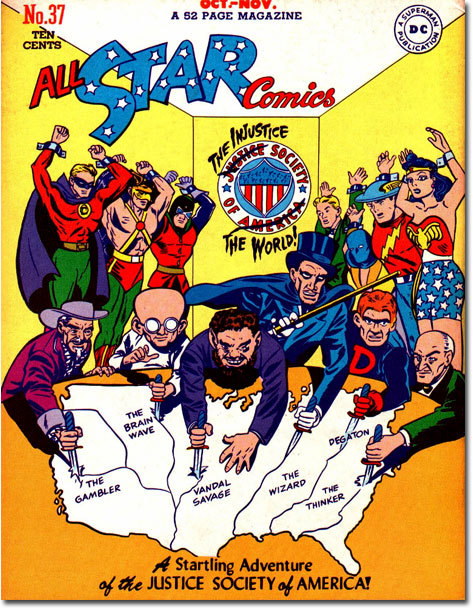
1947, Oct, All-Star Comics #37 – Injustice Society of the World 
1948, Dec, All-Star Comics #44 – Evil Star
1951, Mar, All-Star Comics #57 – The Key
1999, Dec, Secret Origins of Super-Villains 80-Page Giant #1 – Johnny Sorrow

Hawkman
1940, Jan, Flash Comics #1 – Hath Set
1940, Fall, All-Star Comics #2 - Nyola
1941, Jan, Flash Comics #13 – Satana
1945, Apr, Flash Comics #64 – The Monocle
1947, Oct, Flash Comics #88 – The Gentleman Ghost


Plastic Man
1950, May, Plastic Man #23 – The Figure
1950, Sep, Plastic Man #25 – Mr. Aqua

The Spectre
1940, May, More Fun Comics #55 –  Zor
1940, Win, All-Star Comics #3 – Oom

Aquaman
1941, Dec, More Fun Comics #74, Blackjack

Green Arrow
1946, Sep, World's Finest #24 – Bulls-Eye

Dr. Mid-Nite
1947, Feb, All-American Coics #82 - Dr. Light

Starman
1941, May, Adventure Comics #62 – The Light
1941, Oct, Adventure Comics #67 – The Mist

Vigilante
1941, Win, Leading Comics #1 – The Dummy

Zatara
1938, Apr, Action Comics #1 – The Tigress
1938, Oct, Action Comics #5 – Amen-Hotep

Congo Bill
1940, Jun, More Fun Comics #56 - The Skull

Robotman
1943, Feb, Star-Spangled Comics #17 – The Turtle

Wildcat
1943, Ago, Sensation Comics #20 – Yellow Wasp
1947, Ago, Sensation Comics #68 – The Huntress

Sandman
1942, Sum, World’s Finest Comics #6  - Ramulus

Boy Commandos
1946, Jun, Boy Commandos #15 – Crazy Quilt


RELATED ARTICLES: