Saturday, May 28, 2016

DC Universe: Rebirth #1 —Una carta de amor de Johns a la esperanza, el optimismo y el legado

Ya se publicó el primer número del DC Universe: Rebirth, y todo el mundo parece estar enamorado de él.

Rebirth es otra revisión a la continuidad del Universo DC. Es impulsada por la nostalgia, y amenaza con cometerle sacrilegio a la obra maestra y sacrosanta de Alan Moore... Pero con suficiente razón, fue bien recibido.
Rebirth en resumen.
El primer número, escrito por Geoff Johns, abre mostrando el mecanismo de un reloj que le pertenece al narrador. Es perfecto salvo por un solo engrane malo, que evita que el resto funcione. Al final,

—spoiler menor— 

se compone el engranaje. Esta metáfora es obvia: el Universo DC tiene un error (perdición, pecimismo y corte con el pasado), este primer capítulo promete arreglarlo, y empieza satisfaciendo una demanda de muchos fans. Esto es un posible presagio del final de Rebirth y de la forma en la que este cambiará el Universo DC.
Muérete de envidia, Miguel Ángel.
La continuidad que Rebirth critica se conoce como "Las Nuevas 52" o "el nuevo Universo DC" (DCnU, por sus siglas en inglés), fue creada en el 2011 tras la mini-serie Flashpoint. Como todas las continuidades anteriores, no se inició con los nuevos orígenes para cada personaje —estos vinieron después—, sino con nuevas historias que no dependen de un bagaje de años de continuidad. Resultó una eficiente introducción para muchos nuevos lectores, pero también un sacrificio de millones de páginas de la historia de DC.

Conforme fue revelado el pasado de "Las Nuevas 52" (o informalmente, el DCnU), lectores veteranos se enteraron de que muchos de sus personajes e historias favoritas nunca existieron. En las Nuevas 52 personajes como Wally West y Donna Troy no existen, las nuevas versiones de los personajes de la era dorada, como Jay Garrick o Alan Scott son demasiado diferentes y viven en una tierra paralela, el Martina Manhunter, el Hombre Elástico, y Zatanna nunca pertenecen a la Liga de la Justicia, Tim Drake apenas conoce a Batman, y así hay muchas situaciones. Además, todos los títulos perdieron la numeración que llevaban, algunos desde los años 30s. Para muchos lectores, el Nuevo 52 parecía ser negacionismo.
Una de las imágenes inaugurales de Las Nuevas 52.
Muchos fans también percibieron un exceso de violencia y pesimismo. Después de Flashpoint (2011, también por Geoff Johns), el primer número de Detective Comics muestra la cara del Joker arrancada, la primera Red Hood and the Outlaws muestra una Starfire sin recuerdos o amor por sus viejos amigos, el primer Batman muestra un psicópata versión de James Gordon Jr., y el primeros de Catwoman muestra una relación de Gatúblela con Batman meramente sexual sin emoción. Además, muchos matrimonios y relaciones de pareja (Luisa y Clark, Arthur y Mera, Ollie y Dinah, Dick y Kory) dejaron de existir.
Lo que está en juego en Rebirth.
Wally West narra la historia (esto no es spoiler, es claro desde las primeras páginas) y habla de toda la esperanza y el optimismo que se había perdido después de Flashpoint. No es que las cosas eran exactamente felices después de Crisis de Identidad (2004), pero la historia de DC todavía contaba. En Rebirth, la causa es recuperar el legado de DC.


Geoff Johns también hizo Crisis Infinita en 2005, que también se trata de la percepción de que el Universo DC es lugar oscuro y pesimista, solo que en esa historia el que quería devolver la esperanza y el optimismo, Superboy Prime, era el villano y una parodia de fanboys nostálgicos. En Flashpoint la nostalgia y el legado que se perciben y celebran como algo bueno, algo que los héroes quieren.

Claro, la identidad del villano de Rebirth es un meta-comentario sobre Watchmen (Alan Moore, 1986) y su influencia en los cómics de súperheroes. Esto deja interrogantes: ¿En verdad le echan la culpa del pesimismo y la violencia a Watchmen?¿mantendrán el punto de Watchmen intacto? ("entérese for el mismo baticanal, a la misma batihora"). Es demasiado pronto para pensar lo peor. Tratar con una franquicia tan respetada y sus personajes es una tarea compleja, veremos si Johns es capaz de manejarla.

Como un primer acto de la serie, ofrence adelantos de Ted Kord y Ray Palmer teniendo a Jaime Reyes y Ryan Choi como sus protegidos en lugar de sus remplazos, así como la promesa de regresar a los héroes de la era dorada y las relaciones amorosas. Eso es lo que está en juego en esta serie.

Como una historia Rebirth está bien. Como sucede usualmente en las historias de Johns hay mucho énfasis en los asuntos de padre e hijo, en lo que el narrador recuerda o completamente feliz o completamente trágico, o de como los chicos con el corazón en el lugar correcto superan a bullies estereotipados (en EEUU les llaman bullies de los "after school specials" de la TV).

DC Universe: Rebirth #1 no es una obra maestra Mooreana, sino un hit eficiente con muchas probadas y in esperado mensaje editorial de optimismo y esperanza. Finciona bien como una historia, pero excelente como una declaración de misión.
Esperanza, optimismo y legado.

DC Universe: Rebirth #1 —Johns's love letter to hope, optimism, and legacy

The first issue of DC Universe: Rebirth is out, and everybody seems to be in love with it. It is yet another revision to the DC Universe continuity, it is driven by nostalgia, and it threatens to commit sacrilege to the most sacrosanct masterpiece of Alan Moore... But with good reason, it was well received.
Rebirth in a nutshell.
The issue, written by Geoff Johns, opens by showing a perfectly good watch clockwork with one bad gear preventing it from working. By the end,

—minor spoiler— 

the gear is fixed. This metaphor is a no-brainer: the DC Universe is all wrong. This first chapter promises to fix the DC Universe and starts by satisfying a demand of many long time fans; more hope and optimism. The metaphor works as a possible presage to the way this series will change the DC Universe.
The Renaissance of the DC Universe.
The narrator of Rebirth criticizes the continuity created in 2011, officially called the New 52 and created after the Flashpoint mini-series. Like all previous continuities, it didn't start with the new origins of each character —those came later—, but with new stories that didn't rely on a baggage of previous stories. It was an efficient introduction for many new readers, but a sacrifice of millions of pages of DC history.

As the past of this new "the New 52" continuity was revealed, long time readers learned that many of their favorite characters and storylines never happened. In the New 52 multiverse sidekicks like Wally West and Donna Troy don't exist, the new versions of the golden age characters like Jay Garrick or Alan Scott are way too different, the Martina Manhunter, the Elongated Man, and Zatanna never belong to the Justice League, Tim Drake barely knows Batman, and so on. Furthermore, all titles lost their numbering, even those that started it in the 1930s. For many readers, the New 52 seemed to be denialism.
One of the inaugural images of the New 52.
Another perceived problem was the excess of violence and pessimism. After Flashpoint (2011, also by Geoff Johns), the first issue of Detective Comics shows the face of the Joker peeled off, the first Red Hood and the Outlaws shows a Starfire with no memoríes or emotional attachment, the first Batman shows a psychopath version of James Gordon Jr. And along with that, many marriages and love relationships (Arthur and Mera, Lois and Clark, Ollie and Dinah) ceased to exist.
This is what is at stake in Rebirth.
Wally West narrates the story (no spoiler there) and he talks about all the hope and optimism that was lost after Flashpoint. Not that things were exactly happy after Identity Crisis (2004), but all the previous DC history was still there. In Rebirth, the cause is recovering DC's legacy.

Geoff Johns also did Infinite Crisis in 2005, which is also about the perception of the DC Universe as a pessimistic dark place, only that time the guy who wanted to restore hope and optimism, Superboy Prime, was the villain and a parody of nostalgic fanboys. In Flashpoint nostalgia and legacy is perceived and celebrated as a good thing, something that the heroes want.

The identity of the antagonist of the story, of course, is a meta-commentary on Watchmen (Alan Moore, 1986) and it's influence on comics. This raises many questions. Is the story actually blaming the pessimism on it? Will Rebirth keep the point of Watchmen? This seems like a cliffhanger of the 1966 Batman show ("Tune in tomorrow. Same Bat-time, same Bat-channel, same Bat-peril") with Watchmen in Geoff's trap, but it's too soon to think negatively. Dealing with that franchise and its characters is a complex task, we will see if Johns is able to pull it in the upcoming issues.

 As a first act, it offers previews of Ted Kord and Ray Palmer having Jaime Reyes and Ryan Choi as their protegees instead of their replacements, as well as a promise to bring back the golden-agers, and love relationships. This is what is at stake for the rest of the series.

As a story it is fine. As it usually happens in Johns's stories there is a lot of emphasis on father-and-son issues, on the stuff that heroes remember as absolutely great or terribly tragic, and on how they have their hearts in the right place and they overcome after school special bullies.

DC Universe: Rebirth #1 isn't a Moorean masterpiece, but an effective hit with lots of teasing and a long expected editorial message of optimism and hope. It works fine as a story but excellent as a mission statement.
Hope, optimism and legacy.


Friday, May 27, 2016

End of Secret Six


The fourth volume of Secret Six is over.

The series is lots of fun (if anything it, could have used two or three extra issues), and it made great contributions to the diversity of DC characters, but it's also noteworthy because of its contribution to Ralph and Sue Dibny as characters.

As its last cover shows, this incarnation of the Secret Six is about a family of quirky misfits brought together by a common enemy. In contrast, the previous incarnation of the Secret Six is a group of key players within the DC Universe supervillain community who refuse to join a syndicate of super-criminals called Secret Society of Supervillains.

In the first two issues of this series, we see Catman —a classic minor enemy of Batman and part of the previous incarnation of the Secret Six—  get captured and tortured along Big Shot, Porcelain, Black Alice, the Ventriloquist, and Strix. The five of them characters apparently created by Gail herself (one of them is soon revealed to be another classic character in disguise).

After their rough start, despite their shenanigans, Ralph Dibny keeps them together in a suburban house outside Gotham City, where they fight the Riddler, a Lovecraftian menace and the League of Assassins.

It would seem pretty odd to see the Elongated Man, a character usually associated with very straight and heroic people, with criminals and misfits, but we can guess that Gail was paying some tribute to the hardboiled roots of the characters. Ralph and Sue Dibny are famously based on Nick and Nora Charles, from The Thin Man.

Despite their wealth and happiness, Nick and Nora love to party and drink with all sorts of people from Nick's past as a private detective. They also take care and almost adopt the troubled Dorothy Wynant. All of this is very similar to the way Ralph and then Sue take care of Catman, Porcelain, the Ventriloquist, Strix, and especially Black Alice.

The Thin Man was originally a novel, but MGM made a film adaptation and several sequels out of it. The book and the scripts for the first two sequels were written by Dashiell Hammet, which might explain the way Gail portrayed Damon Wells as blue collar, hardboiled detective, and Sue appears to be a femme fatale at first. Of course, there are no sources to back this kind of similarities as something Gail intended, but they are still there.

Intended or not, the fun part about it is that Secret Six is the origin story of Ralph and Sue within the New 52 (some of that might remain as part of the upcoming "post-Rebirth" continuity), and Gail just gave them a backstory that pays tribute to their  hard-boiled roots.


Saturday, May 14, 2016

Darwyn Cooke

The Universe wasn't big enough.

If there was a guy I've always wanted with a blank check to write DC characters however he wanted, that is Darwyn Cooke.

... Just imagine: Earth-D.

Well, there probably is one now. 


Thursday, May 5, 2016

The first Superheroines in comics

It is common to think the superhero genre is dominated by male protagonists, and it is. It has been that way since the beginning... although not as much as we think. A little googling and some listing can show us that there were a lot of golden age superheroines (or mystery women) and that they were as talented and independent as their male counterparts.

After reading a bit about Lady Luck, the theme picked my interest, and since the last month, I've been doing this list on my free time. It covers superheroines of the golden age of comic books (c. 1936 - 1953) and provides basic info on each character (publishers, first appearance, general premise), as well as some comments I make about their innovations, influences, originality, fashion sense, impact, and influence.

This is a really long post and I don't expect anybody to read the whole thing. However, it has many sections about different characters, so it's a "pick your favorite" sort of situation. The advantage is that having all of it in one post allows us to compare and see the relevance of each character.

Good girl art, superheroines, censorship, and feminism

By comparing superheroines with their male counterparts, we can get an idea of their equality. It's clear that publishers were just cashing on the "good girl art" (drawn pin-ups with a focus on their "headlighs" and other female parts —the term was coined later by David T. Alexander), which resulted from making female versions of popular male superheroes, without realizing the positive implications for equality and feminism. They were creating fictional women who were not only equal to regular men but epic superhumans, such as Tarzan, Buck Rogers, The Shadow, The Phantom or Superman.

A little context is necessary. The golden age of comic books coincided with the Hays Code, which moderated the amount of violence or sex (or even cleavage) movies could show, and was enforced from 1934 to the late 1950s. Since pulps and comics were largely uncensored back then, they became the biggest outlet for that kind of content. And the fastest way for publishers to serve it was drawing women in Tarzan or Flash Gordon mini-costumes beating thugs.
I think this image is making a commentary about its readers.
One could certainly argue that such representations objectified women —titillating male readers and indulging their escapism, and they certainly do all of that—, but they also made them look like their counterparts: admirable men in even fewer clothes. If Sheena, Mysta or Namora wear skimpy clothes, Tarzan, Flash Gordon or Namor wear even skimpier ones, and the six of them have skills beyond normal men. This is the rationale that made feminist Gloria Steinem ask DC Comics to bring back Wonder Woman's star-spangled bottom.


Friday, March 25, 2016

The Elongated Man is finally back!


... In the yellow costume —for some reason—, but he is back!

As lame as this picture is, I'm glad to see him for the first time as part of the new continuity.

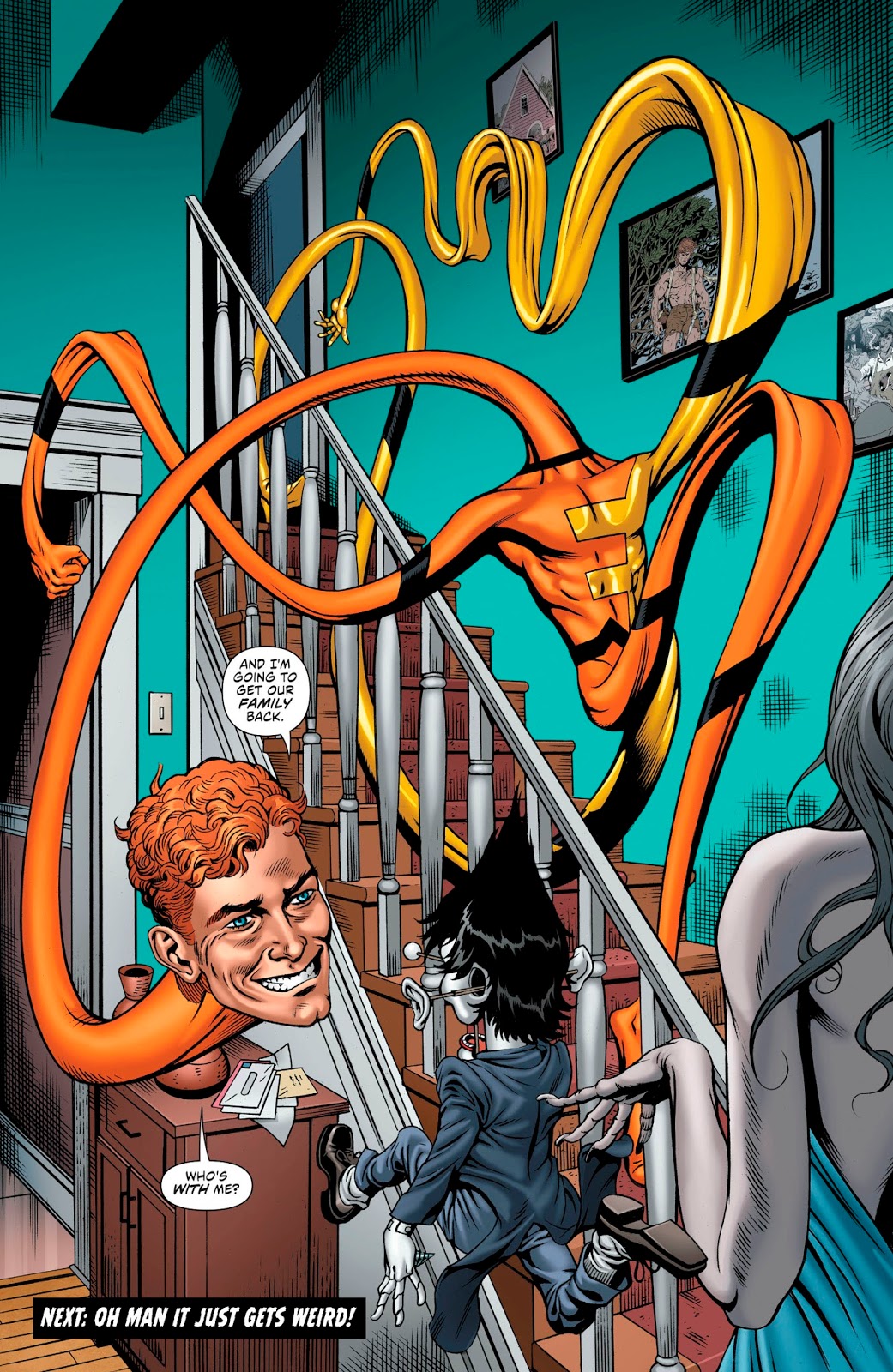
Ralph and Sue Dibny finally return to their regular selves in the pages of Secret Six #12. Almost five years after the current continuity started, this is the first formal appearance of Ralph in full costume, and he seems to be back in business.

The new uniform is weird, though. It was a tough call since there was no perfect uniform, though. Telling from what fans share in their pages, I think there seems to be some sort of untold consensus that purple is the color and the uniform from Justice League Unlimited are the best fit —even if Ralph barely made three cameos in the entire series.

Ralph has only worn yellow a couple of times: the first the classic red uniform colored yellow in Detective Comics # 357, 1966, and the second, in Gotham Knights #41, 2003, is different from all the other uniforms.

The big 'E' and the design of the uniform seems to be inspired by the uniform Ralph wears guring second half of his time with the Justice League Europe (the half almost nobody remembers, though).

It is a bit weird that it took so long for Ralph to ditch the Damon "Big Shot" Wells persona. During the last arc, the rest of the Secret Six knew his secret but he kept doing the accent and the mannerisms. Maybe I missed the reason, or maybe it will be explained.

Anyway, the important thing is that Ralph is fully back. So, let's just hope he won't do that silly stairs walk all the time. To be fair, after the Infantino days, his stretching became weirder and less functional.

Also, Sue is a light brunette. I'm not big on that, but then again, she's back, and that's good enough*.


*Yes, I'm aware that she is likely a mole, but we all know how things go. She'll eventually return to her regular self. Hopefully, with black hair**.

**UPDATE: In a comment, I asked Gail Simone if Sue was a brainwashed mole... and she said that she is just her regular self! So, this is it! The Dibnys are back, and they are in the great hands of a talented writer, leading some lovely misfits into the right path —just like Nick and Nora did in The Thin Man with Dorothy Wynant.

Saturday, August 29, 2015

Ralph and Sue's legend is still strong 1000 years later!

... In the form of a themed Grill & Bar.


There are many interesting things going on with the above image from the fantastic third issue of  Justice League 3001. I'm sure Keith Giffen and J. M. DeMatteis were just having fun, but that's what happens when you have talented craftsmen on the job.

Among the extras we can see the somebody looking like Ambush Bug, a creation of Keith, and another guy resembling the Shadow (perhaps an homage to Andy Helfer?). The Chrysler Building seems to be on the background, which would mean we are seeing the New York City of 3001 AD, when Earth is a dumpster called Takron-Galtos, a place for criminals and low lives.

The restaurant sign alone reveals that there is a Ralph and Sue themed bar and grill, which might lead us to assume a number of things. Until we see the next panel!

You are thinking "is that Wolverine next ot Clark?", but in this picture,
there are a couple of DC regulars hidden in plain sight as well.

There's something funny going on. Let's take a closer look.


Those are freaking Ralph and Sue!! 

I won't get ahead of myself. We have two great options. In the worst case, those are not resurrected Ralph and Sue, which means their legend was so strong it lived as a franchise for almost 1000 years. But let's be practical, if Barry was resurrected for the 3rd time, and we know Firestorm (in control of Cadmus) is now reviving even guys like Gardner, odds are those are resurrected Ralph and Sue and they own a place now. Only Keith and J.M. know the answer and future plans for the characters.

This is a great year for Dibny fans.

By the way. I cannot recommend enough to buy this series. The creative team is a guarantee, and, after a great start, it has been getting more and more entertaining with every issue. The art is fantastic, the story is great and it's impossible not to care about these characters. Not because they are beloved DC icons, but because the compelling way they are written. 

Wednesday, August 19, 2015

SUE IS ALIVE!!

It took four years, but Ralph and Sue Dibny are finally revealed as part of The Secret Six title. 

Secret Six, vol. 4, #5.

This is all thanks to Gail Simone. I'm really glad she did this. Detectives are always a perfect fit for a title like Secret Six, I think Ralph and Sue can work great with the team and are perfect enemies for the Riddler.

Part of the charm of Catman was the way he worked when paired with Deadshot. Both of them are tough alpha men. With his partner gone, I think Ralph is a great replacement. It's different: Ralph is a bit of a geek, always optimistic and assertive, and while he never misses a thing, he can be quite laid back and a bit of a class clown. That's nothing like Deadshot, but changing dance partners is always interesting (it's what keeps so many people hooked to Game of Thrones). So, the switch is interesting and I think along with Sue, Ralph can be key in moving Catman forward on his way to become a full hero.

Sure, with Scandal and Rag Doll outside the roster it's possible to speculate that Big Shot and Black Alice won't stay. Then again, without Deadshot, the book needs high profile characters, and  detectives Ralph and Sue fit the part just fine.

I borrowed this pic from Bleeding Cool, which borrowed it from Secret Six, vol. 4, #5. 
The background story of the Dibnys seems a little changed. I hope they figure out a way to tie it with Barry Allen again. However, as long as the characters remain true at the core, I think this is a good thing. This is not classic DCU, just the New 52 (I don't know about my kind readers, but it's not one of my favorite continuities, anyway), and stories are different.

The Flash # 138
It's possible that the story is going to have Sue brainwashed to become the Riddler's girlfriend or lover and it might elongate the drama for a while. I guess that might get kind of rapey (it depends), which is not precisely cool with Dibny fans, but at least is not Identity Crisis rape, and, again, it's the new 52, so, I take it with a grain of salt. A writer has to take some risks in order to make a good story and Gail has a lot of talent.

Something that is worth noticing is that "the Star of India" is an obscure and classic plot device from Flash #138, in which the Pied Piper stole it and Ralph and the Flash had to recover it. I love that Gail included it in this story. It means that she knows her Elongated Man. I'd love to see revivals of any of the other classic elements like the birthday mysteries, Billy Warner (president of the Elongated Man fan club), the visits to France (Ralph is even more popular there), the Batman and Flash crossovers, Amos Hurd "the Cowboy Millionaire", the Elongated Evildoer, the circus performances, the nods to Doyle, Christie, Poe and everything about the Thin Man and I think this list went on for too long.

So, yeah, with Convergence, Justive League 3000 and Secret Six, 2015 is the year of the Dibnys. I really hope Gail elevates them both to high profile status, like she has done with many characters in the past.

Monday, August 3, 2015

Elongated Man in Multiversity

According to Grant Morrison's The Multiversity, at least a couple of versions of Ralph are still around in DC's multiverse.

The Multiversity is a limited series that explores multiple universes of the current continuity of DC Comics. In later years, the Elongated Man didn't even make cameos, however, that changed with The Multiversity Guidebook, the sixth issue of the series, which goes into detail of the entire multiverse and shows a list including most of its universes.

On Earth 44, as shown in page 57 of The Multiversity Guidebook, the equivalent of both the Justice League of America and the Metal Men is The Metal League. Created by Dr. Will Tornado, Gold Superman, Iron Batman, Platinum Wonder Woman, Nth Metal Hawkman, Lead Green Arrow, Mercury Flash and, yes, Tin Elongated Man.


They are all robot versions of the Justice League, the fun part is that is that the only human member is the equivalent of the only robot member of the actual league. 

Another version of the Elongated Man can be seen on Earth 26, which is the equivalent of what used to be "Earth C", during the early 80s. A world populated by anthropomorphic animals, including Captain Carrot and his amazing Zoo Crew, a superhero team. They are original characters rather than analogues of the Justice League, but it's worth noticing that one of the most prominent members, Rubberduck, has the exact powers of the Elongated Man and nicknames like "the ductile duck" or "the malleable mallard", equivalent to Ralph's "the ductile detective" and "the malleable marvel". 

In the old stories, the focus of the stories is Captain Carrot, and he is a comic book artist in his civilian identity. The title he draws is Just'a Lotta Animals, which features anthropomorphic animal versions of the Justice League of America. However, as it always happens in the DC multiverse, what is comic book fiction in one universe is reality in another. So, those Justice League parodies turned out to exist in their own universe, called Earth C-, and they even met Captain Carrot and his friends "The Zoo Crew" in some stories. 

In The Multiversity #2, during the crisis across the multiverse, the Zoo Crew is seen fighting Just'a Lotta Animals. Which, again includes a version of the Elongated Man, in this case, the Elon-Gator.

It wasn't specified if the new Just'a Lotta Animals and Zoo Crew live in different universes like they used to do (Earth C, and Earth C-). We only know that they have a fight on Earth-26, which belongs to the Zoo Crew, but no universe was listed as belonging to Just'a Lotta Animals. However, in the Multiversity series, 7 universes were left unknown, including Earth-25 and Earth-27. 

Most of the 52 universes include a version of the Justice League, commonly based on the 3 incarnations: the original "big 7", the new big 7 (with Cyborg replacing Martian Manhunter) and the satellite era. Clearly both the Metal League and Just'a Lotta Animals are based on the satellite era. However, it can also be argued that Elon-Gator was probably included to provide a visually interesting counterpart to the more recognizable Rubberduck.

Oddly enough, I don't remember a single Plastic Man in any Justice League analogue, despite the fact that Morrison himself made him a member. The exception might be Morphin' Man, a parody of the completely obscure Polyman, who is, in turn, a pastiche of both Elongated Man and Plastic Man.


I don't really know if the old realities are back after Convergence, (yet another miniseries in which characters from old or erased time lines get a second chance), but, so far, this year I have seen the return of the classic, pre-Crisis, Elongated Man, as well as the pre-Flashpoint one, the version from the Giffen-DeMatteis stories in Justice League 3000 (another unidentified universe), the Elon-Gator, Rubberduck, and Tin Elongated Man. Plus, on the main universe of DC Comics, Earth-0, there is a mysterious character called Ralph Dibny, despite the fact that he doesn't look anything like the real deal.

Some other universes like Earth-22 (Kingdom Come) are known to have a Ralph Dibny. Due to their connection with Juistice League Unlimited, in which he was a character, Earths 12 and 50 probably have other versions of him. It's also safe to assume that many of the other universes feature him, specially those with versions of all the characters of Earth-0 or Earth-1. 

All of this isn't really a comeback for Ralph Dibny, since he is not really part of a team with an ongoing title. However, at least his existence is acknowledged and he becomes available for any writer who might want to use him in upcoming stories. 


Monday, June 29, 2015

If I'm not mistaken... Ralph and Sue lived longer in JL 3000!

It all depends on this picture from Justice League 3000 #14. That's a flasback with (left to right) Ralph, Max, Oberon, Ice and Sue, showing a moment, way after the Super Buddies issues, sometime after Fire exchanged places with Ice at hell.
The story also states that Ice never saw Fire again, however,
a. that's not how Ice revived in the pre-Flashpoint continuity, as seen in Birds of Prey #105 (July 2007),
b. Fire and Ice reunited and teamed up in Justice League: Generation Lost (2010),
c. by the time Ice was resurrected in the pre-Flashpoint continuity (July 2007), both Ralph and Sue were dead and Max had turned evil.

If I'm correct and those are Ralph, Max and Sue, it means we have our first post-Flashpoint continuity in which they are still alive at the present time!!

And here is a cool picture of the whole gang. Just because:


Update: I've confirmed it at J.M. DeMatteis blog, CREATION POINT (actually, he did said so in an interview that I missed before I asked). By the way, that blog is really awesome, J.M. is incredibly cool and gives honest answers to about everything.